A FERRO ROD IS JUST THE BEGINNING.
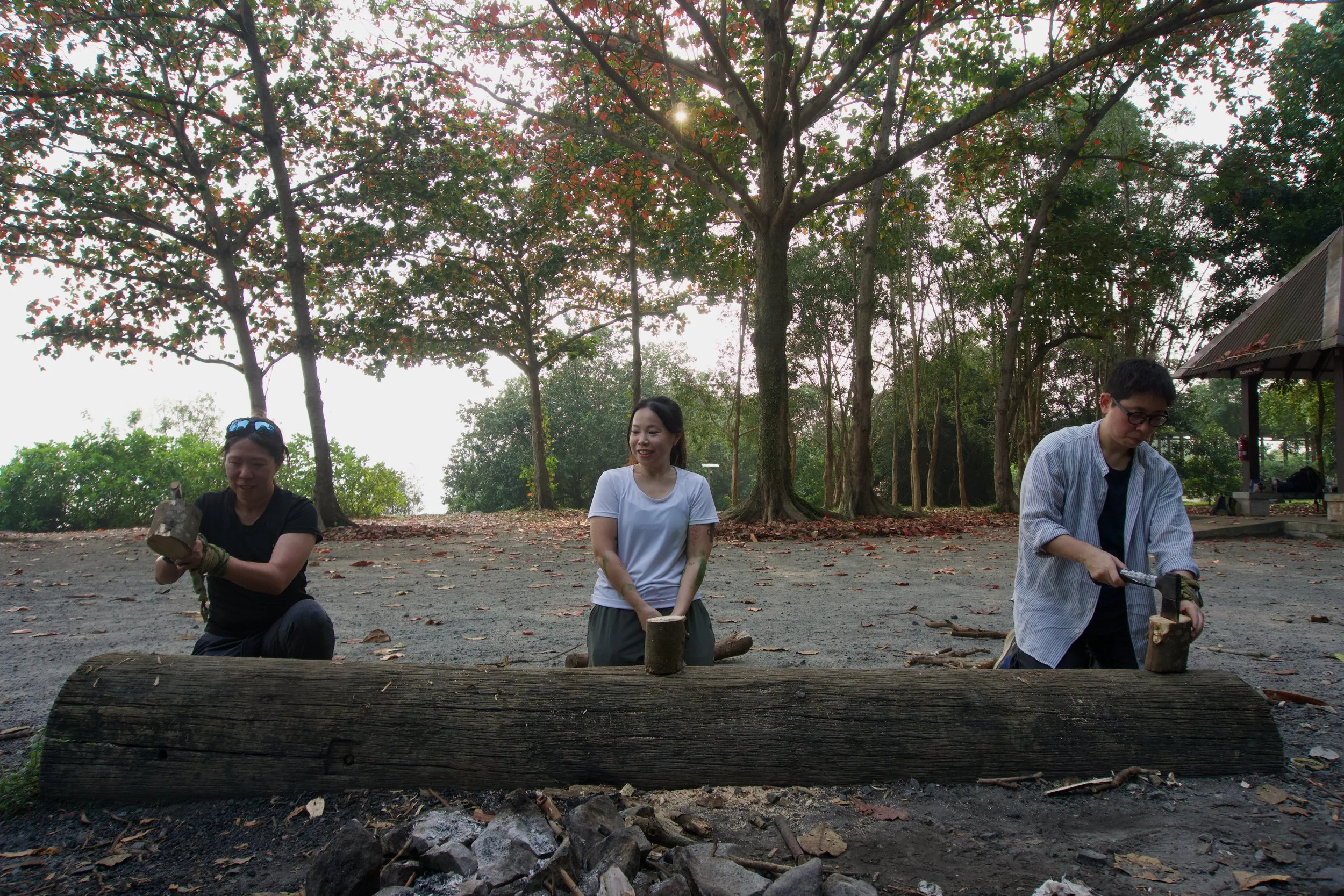
How Beyond Expeditions’ three-level survival programme takes you from your first spark to friction fire, functional builds and practical field application on Pulau Ubin.
There is a problem with learning survival skills from the internet. Everything works suspiciously well.
One strike. Perfect fire. Three cuts. Perfect shelter. Someone ties a knot without once wondering where the other end of the rope went.
Real life is less cooperative. Wood is wet. Cord slips. The branch is the wrong diameter. The tinder you thought was dry is absolutely not.
And the fire does not care that you watched six videos about it the night before.
That is why Beyond Expeditions’ survival skills programme in Singapore is built across three progressive levels on Pulau Ubin. Not three collections of activities. A progression.
Level 1 teaches the foundations. Level 2 makes those foundations build something. Level 3 begins removing some of the convenient options and asks you to combine more of what you already know.
Because a ferro rod is useful. But it is only the beginning.
THE THREE-LEVEL PATH.
- Fire.
- Natural materials.
- Tools.
- Cooking.
- Knots.
- Mallet.
- Stool.
- Shelter.
- Stretcher.
- Friction fire.
- Field stoves.
- Integrated survival application.
MAKE THE FUNDAMENTALS WORK
Level 1 is where everybody starts. You do not need previous survival experience, you do not need to know your knots, and you do not need to own an axe.
You also do not need to arrive pretending you already know what you are doing.
The aim is simpler. Learn the foundations properly.
FIRE. WOOD. ROPE. FOOD.
The Level 1 Survival Workshop currently introduces:
natural-material selection
fire lighting
outdoor cooking
wood sawing and chopping
knots and lashing
The list only tells half the story. The important part is how those skills begin connecting.
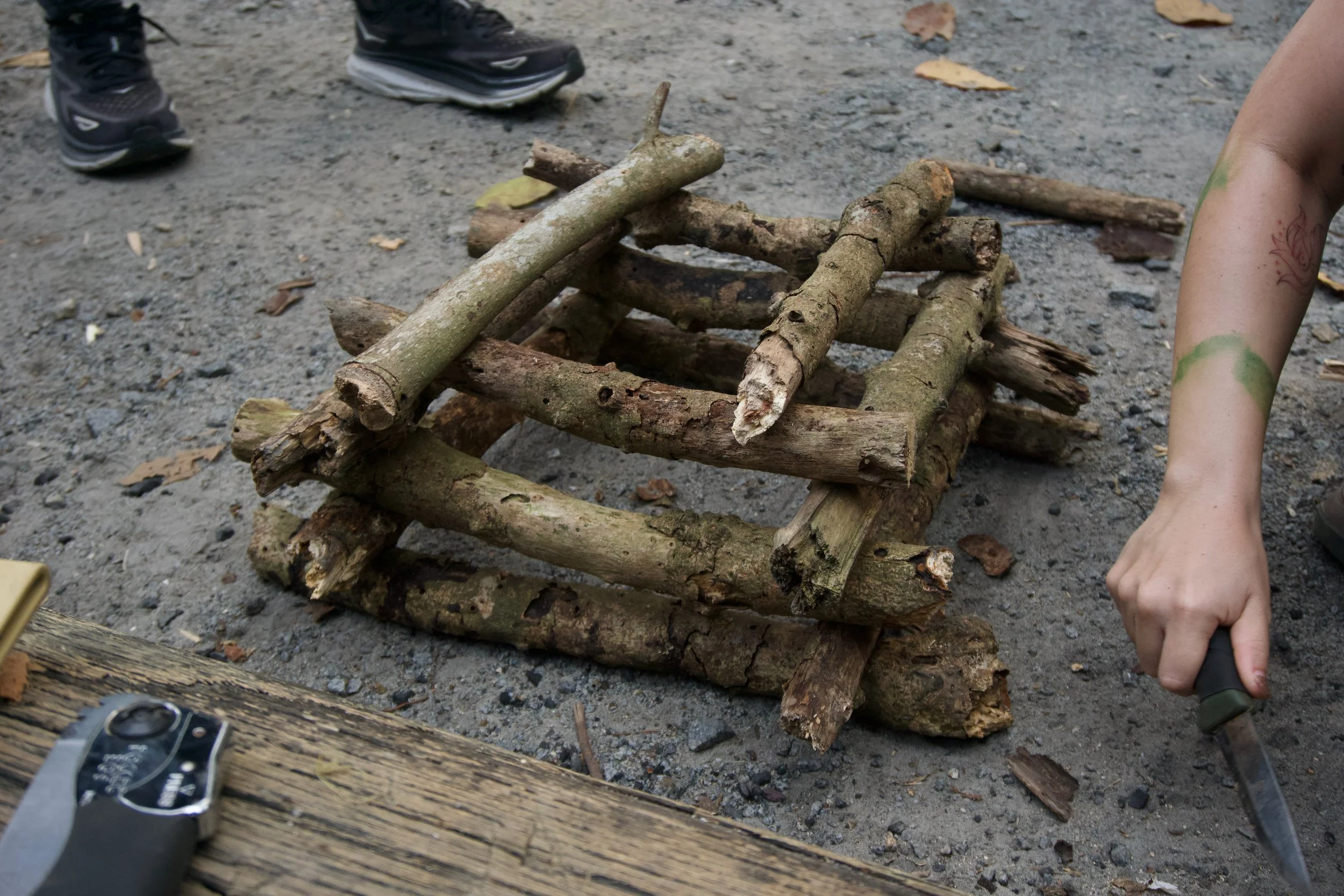
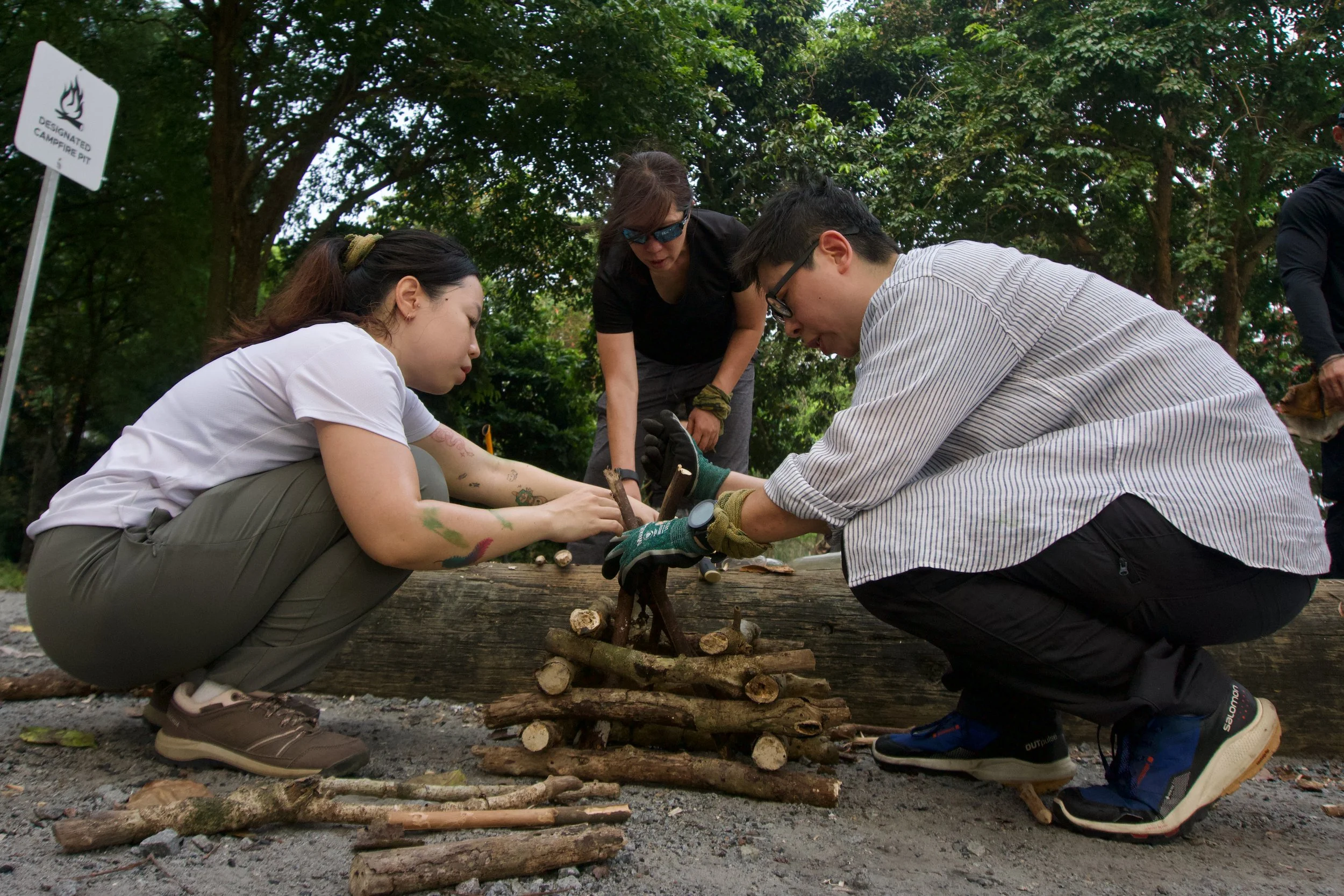
You collect useful natural material because later you need fire. You process wood because a fire needs fuel. You light the fire because eventually you are going to cook over it. You work with cordage because at some point something actually needs to hold.
The individual techniques start becoming useful to one another. That is when bushcraft stops feeling like a collection of clever tricks.
WHY START WITH FIRE?
Because fire gives immediate feedback. Either the material catches or it does not. Either the flame progresses or it dies. There is no polite middle ground.
A ferrocerium rod is a useful training tool because it removes the convenience of a lighter while still giving a beginner a realistic way to create ignition. It can produce very hot sparks.
But a spark is not a fire. You still need:
tinder
preparation
airflow
fuel progression
enough patience to avoid smothering the whole thing the moment you see a flame
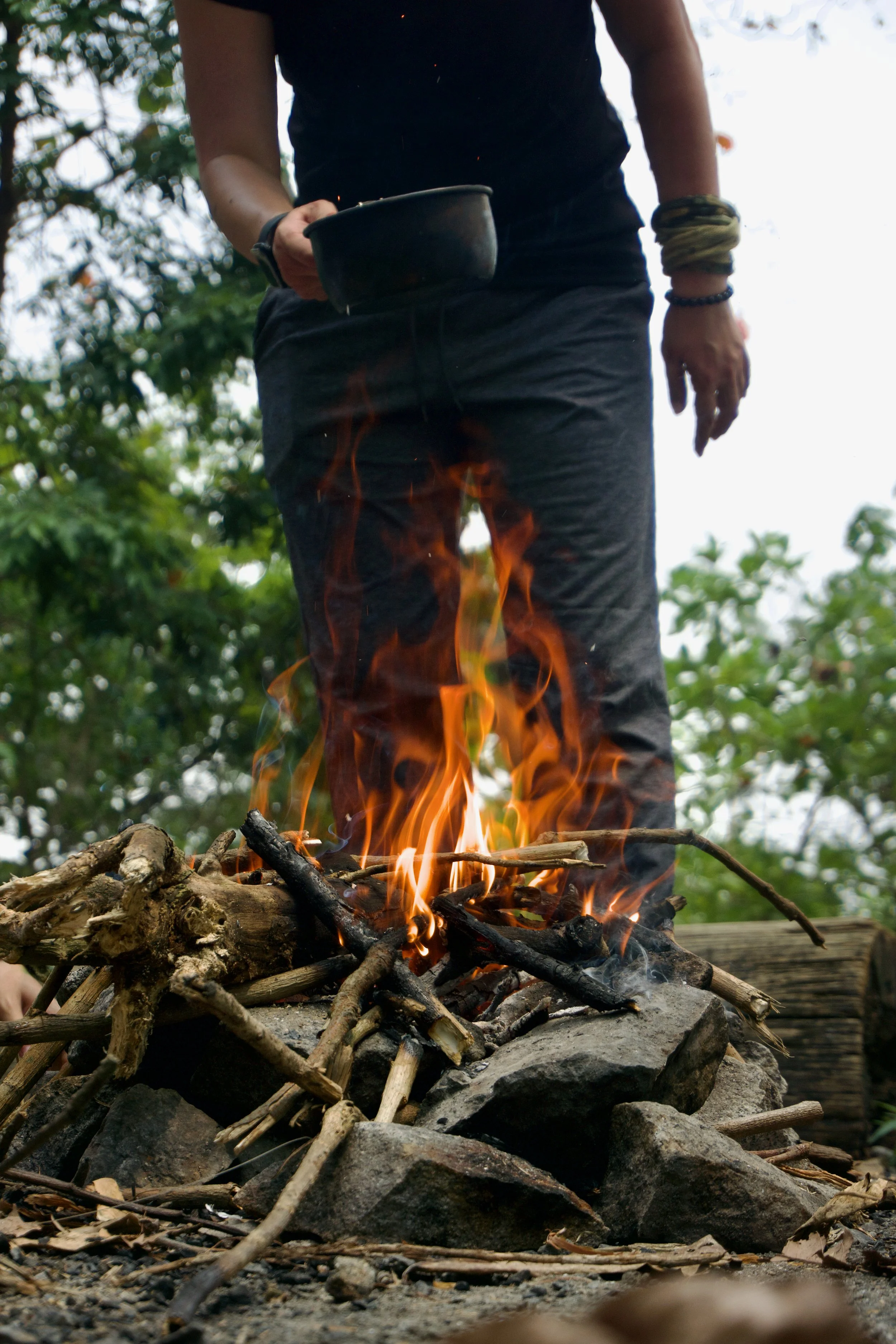
Once that flame exists, the problem changes. Can you keep it alive? Can you build enough heat? Can you cook over it?
The spark was only the beginning.
“A SPARK IS NOT A FIRE.”
WHY TEACH SAWS, AXES AND KNIVES AT LEVEL 1?
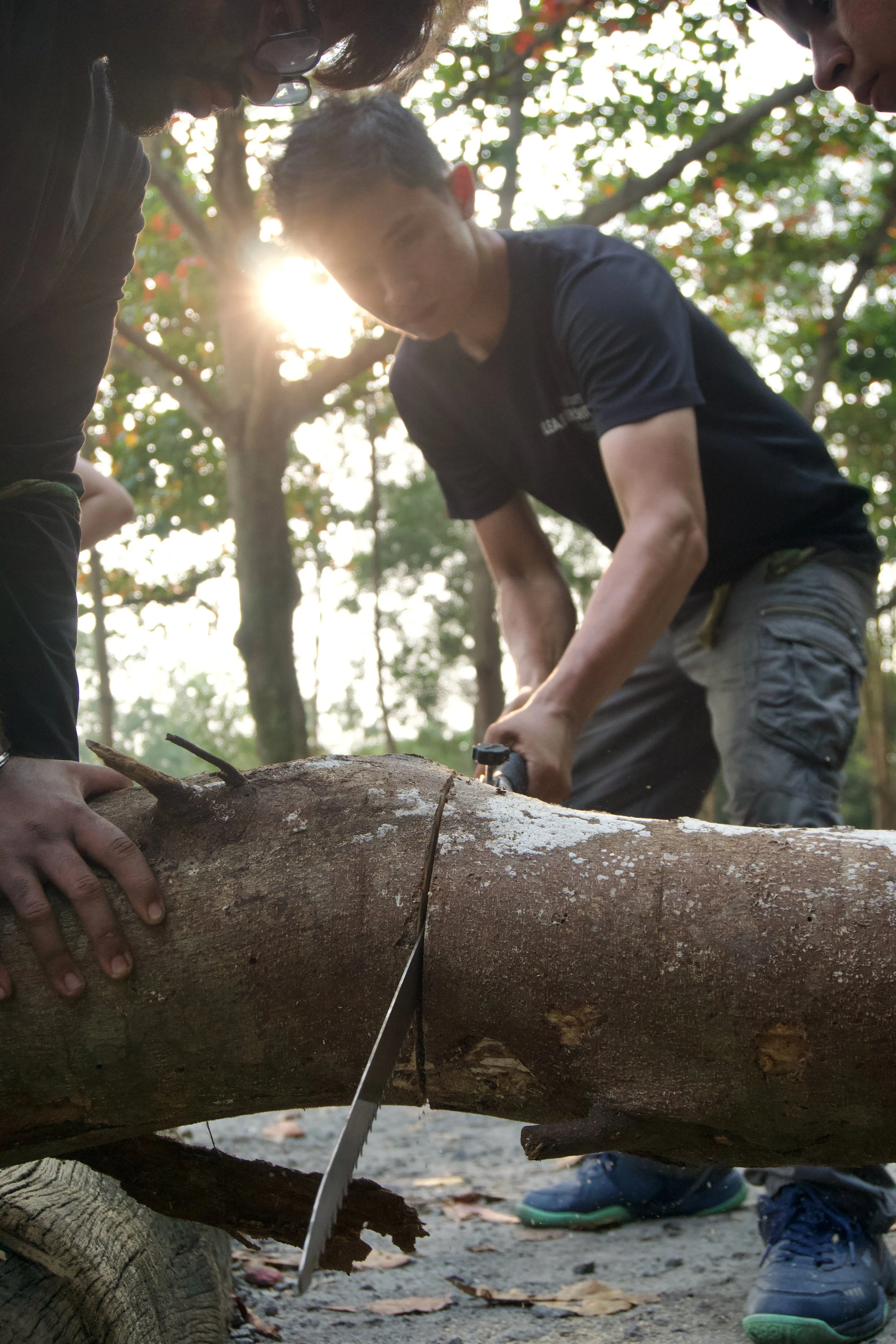
Because wood rarely arrives outdoors in exactly the size you need. Learning to process material gives you options. Saw it. Split it. Shape it. Prepare it.
Different tools solve different problems. A saw behaves differently from an axe. An axe behaves differently from a knife. And none of them become safer simply because the person holding them is enthusiastic.
Level 1 introduces tool handling with an emphasis on control, body positioning, appropriate tool choice and efficiency.
The objective is not to swing harder. The objective is to understand what the tool is doing.
WHY DO KNOTS MATTER THIS EARLY?
Because eventually something needs to hold.
A knot without an application is just something you are trying to remember. A knot used to secure, tension, join or build something suddenly makes a lot more sense.
That principle becomes increasingly important in Level 2. In Level 2, your knots stop living in isolation. Something is going to depend on them.
Learn the foundations well enough that you can actually start using them.
NOW BUILD SOMETHING THAT ACTUALLY WORKS
Level 2 changes the question.
Level 1 asks whether you can perform the technique. Level 2 starts asking whether you can use it to make something useful.
That difference matters. Knowing a knot is one thing. Trusting that knot when a structure has weight on it is something else entirely.
The current Level 2 Survival Workshop moves into four practical builds:
wooden mallet
bushcraft stool
natural shelter
improvised stretcher
Each one takes skills that were introduced earlier and gives them a job.
THE WOODEN MALLET
Why make a wooden mallet when we could simply hand you one? Because the finished tool is only half the lesson.
To make one, you have to think about material selection, grain, cutting, shaping, tool control, and whether the thing you just made is actually useful.
You are no longer practising woodcraft for the sake of practising woodcraft. You are manufacturing something that can help with the next job.
THE BUSHCRAFT STOOL
A stool is wonderfully unforgiving. It either supports you or it does not.
Suddenly, angles matter. Lashings matter. Material choice matters.
And the person who announces that it looks strong enough eventually has to decide whether they are willing to sit on it. That is a considerably better test than a worksheet.
NATURAL SHELTER
Shelter introduces scale. A small demonstration can hide weak technique. A structure large enough to actually shelter people cannot.
Now you have to consider anchor points, material, structure, tension, coverage, and how the individual parts work together.
This is also where different survival skills begin overlapping more noticeably. Woodcraft. Cordage. Site selection. Planning. Execution.
A shelter does not care which chapter of the course a skill came from.
THE IMPROVISED STRETCHER
A stretcher looks simple when it is lying on the ground. Two poles. Some rope. A platform. Done.
Until weight goes on it. Then every shortcut introduces itself.
A good-looking lashing that slips under load is not a good lashing. A strong-looking pole that flexes too much is not the right pole.
The stretcher is one of the clearest examples of the difference between knowing a technique and actually applying one.
“LOOKING RIGHT IS NOT THE SAME AS WORKING RIGHT.”
LEVEL 2 CHANGES THE TEST
By this point, you are no longer learning every skill in isolation. The questions become more practical.
Can the stool hold weight? Can the shelter protect people? Can the stretcher carry a load? Can the tool you made actually help you?
This is where the programme becomes much less interested in whether you memorised the technique, and much more interested in a shorter question. Does it work?
Take the foundations and make them carry weight.
REMOVE THE EASY OPTION
By Level 3, participants have already worked with fire, cutting tools, cordage and functional builds. So the question changes again.
Level 1 asks whether you can learn the technique. Level 2 asks whether you can build something useful with it. Level 3 begins asking what happens when some of the convenient options disappear.
The current Level 3 Survival Workshop moves into:
bow-drill friction fire
rocket stove
Swedish stove
a final survival simulation
This is where earlier skills begin overlapping much more heavily. Firecraft is no longer just about producing a spark. Wood processing is no longer just about practising with a saw or axe.
Cordage, material choice, preparation and decision-making start feeding into larger problems. The individual skills are still there. They are simply becoming harder to separate from one another.
BOW-DRILL FRICTION FIRE
A ferro rod gives you thousands of very hot sparks. A bow drill gives you something much less generous.
Friction. Heat. Smoke. And, if enough things go right, one small ember.
That ember still is not a fire. You still have to transfer it into suitable tinder and convince it to become a flame.
This is why friction fire belongs later in the progression. The entire system matters:
wood selection
spindle
hearth board
notch
bearing block
bow
cordage tension
body position
rhythm
pressure
tinder preparation
A small problem anywhere in the system can stop the whole process.
It is one of the clearest reminders that survival skills are rarely about one dramatic moment. Most of the work happens before the flame appears.
“A BOW DRILL MAKES YOU EARN ONE EMBER.”
ROCKET STOVE
A rocket stove changes the way participants think about fire. Instead of an open campfire, the structure itself begins controlling airflow, fuel direction and heat.
Now the questions become more specific. Where does the air enter? How does the fuel feed? Where does the heat go? How efficiently can the fire cook?
Someone who already understands basic fire preparation can now start looking at fire as a system. The objective is not simply to make flame. It becomes controlling combustion well enough that the fire does useful work.
SWEDISH STOVE
The Swedish stove, sometimes known as a Swedish fire log, takes another familiar material and changes its job. The fuel becomes part of the stove structure itself.
That means earlier skills return:
sawing
splitting
fuel preparation
airflow
fire control
cooking
What looked like separate lessons in Level 1 now start appearing inside the same task. That is the point.
THE FINAL SURVIVAL SIMULATION
The final part of Level 3 is where the programme should begin feeling less like a list of individual workshops and more like a connected skill set.
The final simulation brings earlier learning together in a practical setting. Participants have to draw on skills developed across the three levels rather than waiting for an instructor to announce: now use the knot, now light the fire, now use the saw.
Real outdoor problems are rarely that neatly labelled. The value is in recognising:
what matters
what tool or technique is useful
what needs doing first
and what can wait
Take away some of the convenience and make the earlier skills work together.
SO WHICH LEVEL SHOULD YOU ACTUALLY JOIN?
The answer is deliberately uncomplicated. Start where the foundations start.
The three levels are progressive for a reason. Level 2 assumes Level 1 skills. Level 3 assumes you have already worked through Levels 1 and 2.
Skipping ahead may sound efficient. It usually means missing the exact skills the later workshop expects you to use.
Even if you hike. Even if you camp. Even if you own a perfectly respectable outdoor knife.
Level 1 establishes the shared foundations that every later workshop expects you to already have.
You are not proving that you are a beginner. You are making sure the later skills have something solid to build on.
Level 2 is where individual techniques start becoming functional builds.
You stop asking only whether you can tie this, and start asking whether it will hold. You stop asking whether you can cut wood, and start asking whether you can turn the material into something useful.
If Level 1 teaches the vocabulary, Level 2 starts asking you to form sentences with it.
By this point, you already understand the foundations and have used them in practical builds.
Level 3 begins removing convenience. Friction fire replaces instant sparks. Fire becomes more structural. Skills begin arriving together instead of waiting politely in separate chapters.
This is where the progression starts feeling much more connected.
WHAT IF I’VE NEVER DONE ANYTHING LIKE THIS BEFORE?
Then Level 1 is exactly where you should start.
You do not need previous survival experience. You do not need to know your knots. You do not need to know how to use an axe. You do not need a collection of expensive bushcraft equipment.
The course exists because these are skills people come to learn.
Our recent Level 1 groups have included complete beginners alongside people with previous camping and expedition experience. Both can learn something.
The beginner gets a safe, structured introduction. The experienced participant often discovers details in technique, tool handling and application that were previously overlooked.
That is a better standard than simply writing that a course is suitable for all levels.
I ALREADY CAMP AND HIKE. WILL LEVEL 1 BE TOO BASIC?
Not necessarily. Camping experience and survival-skill competence overlap, but they are not identical.
Someone may be perfectly comfortable sleeping outdoors while rarely needing to:
start a fire with a ferro rod
process wood efficiently
build with lashings
select natural tinder
or work deliberately with different cutting tools
The point is not to prove that experienced outdoor people know nothing. The point is that foundations can usually be refined.
One participant in a recent Level 1 workshop already had camping and expedition experience and still came away reflecting on how much more there was to learn.
Good fundamentals rarely become useless simply because someone has spent more nights outdoors.
CAN I JOIN A SURVIVAL COURSE ALONE?
Yes. You do not need to arrive with your own group.
Public survival workshops are useful precisely because individuals with different backgrounds can join the same session. Someone may arrive alone. Someone else may come with a friend. Another participant may be there with a family member.
Once the practical tasks start, those distinctions become considerably less important.
Someone needs to hold the branch. Someone needs to keep an eye on the fire. Someone finally figures out why the tinder was not catching.
People begin learning around one another without needing a formal teamwork exercise to make it happen.
CAN FRIENDS DO THIS TOGETHER?
Absolutely. Bushcraft works particularly well with friends because people tend to gravitate towards different parts of the problem.
One person becomes strangely invested in fire. Someone else gets obsessed with chopping wood properly. Another decides knots are suddenly fascinating.
You do not need everybody to arrive with the same level of experience. The shared part is the learning.
Private formats can also be designed for friend groups when the goal is less about completing a public course and more about having a specific experience together.
WHAT ABOUT FAMILIES?
Families can learn the same real skills, but the format does not always need to look identical to a public Level 1 course.
Age matters. Confidence matters. Attention span matters. And different families want different things from the day.
Some want more fire. Some want woodcraft. Some want cooking. Some want older children doing genuinely practical work instead of a simplified children’s activity.
That is why private family bushcraft experiences can be adapted around the people attending while still keeping the tools and skills real.
CAN PRIVATE GROUPS BOOK SURVIVAL TRAINING?
Yes. The same core skills can be shaped differently for:
friends
families
birthday groups
private gatherings
and other small groups
The important distinction is between learning the progressive Level 1, 2 and 3 curriculum, and using survival skills as part of a customised private experience.
Both are legitimate. They simply have different objectives.
WHAT ABOUT CORPORATE TEAMS?
The same outdoor skills can also become useful tools in corporate programmes. But the objective changes.
A public survival course focuses on developing the participant’s own outdoor capability.
A corporate survival challenge may use:
fire
shelter
stretcher construction
resource selection
or other practical tasks
to create problems around:
communication
prioritisation
leadership
initiative
adaptability
and working under uncertainty
The fire is not the corporate lesson. The axe is not the corporate lesson. The stretcher is not the corporate lesson. What people do around the problem is.
That distinction matters. It is why survival-based team programmes can remain technically real without pretending office teams are preparing for the apocalypse.
“THE SKILL IS REAL. THE OBJECTIVE CAN CHANGE.”
BUSHCRAFT VS SURVIVAL SKILLS: WHAT’S THE DIFFERENCE?
The terms overlap considerably.
Survival skills generally focus on maintaining essential needs when conditions become difficult or unexpected. That can include:
fire
shelter
water
navigation
signalling
first aid
and practical decision-making
Bushcraft usually places more emphasis on living and working competently in an outdoor environment through skills such as:
firecraft
woodcraft
cordage
tool use
shelters
and campcraft
Beyond Expeditions’ workshops draw from both. But we are much less interested in arguing over terminology than in one practical question. Can you actually use the skill?
By now, the progression should be fairly clear.
The next question is usually practical. How does the whole programme compare at a glance?
LEVEL 1 VS LEVEL 2 VS LEVEL 3
If you are trying to understand the difference between the three workshops without reading another few thousand words, start here.
Each level has a different job.
Level 1 builds the foundations. Level 2 puts those foundations to work. Level 3 makes some of the convenient options disappear.
- Natural materials
- Ferro-rod fire lighting
- Outdoor cooking
- Wood sawing and chopping
- Knots and lashing
- Wooden mallet
- Bushcraft stool
- Natural shelter
- Improvised stretcher
- Bow-drill friction fire
- Rocket stove
- Swedish stove
- Final survival simulation
There is no prize for starting at the hardest level.
The progression exists because the later workshops expect the earlier skills to already make sense.
SURVIVAL SKILLS COURSE FAQs
-
Start with Level 1.
Level 1 is designed to establish the foundations used throughout the programme, including fire lighting, natural-material selection, outdoor cooking, wood processing, tool handling, knots and lashing.
No previous bushcraft or survival experience is required.
-
Camping or hiking experience can certainly help with general outdoor confidence, but it does not always mean the specific Level 1 techniques have been learned or refined.
The three workshops are designed as a progression, so Level 1 establishes the common foundations used in the later levels.
-
Level 1 focuses on foundational techniques such as firecraft, wood processing, outdoor cooking and cordage.
Level 2 takes those foundations into functional builds such as a wooden mallet, bushcraft stool, natural shelter and improvised stretcher.
In simple terms, Level 1 asks whether you can perform the technique. Level 2 asks whether you can build something useful with it.
-
Level 3 introduces more demanding firecraft and broader survival application.
Participants move into bow-drill friction fire, rocket-stove and Swedish-stove systems, and a final survival simulation that requires earlier skills to work together more naturally.
-
Bow-drill fire is a traditional friction-fire technique that uses coordinated movement between a spindle, hearth board, bow, cordage and bearing block to generate heat and eventually create an ember.
That ember must then be transferred into suitable tinder and developed into a flame.
It is significantly less forgiving than using a ferrocerium rod.
-
Beyond Expeditions’ current Level 1, Level 2 and Level 3 survival workshops are conducted on Pulau Ubin, Singapore.
Readers should check the individual programme pages for the latest meeting points, schedules and operational information.
-
Yes.
Public sessions are suitable for individual participants, so you do not need to organise your own group before joining.
Participants often arrive with different outdoor backgrounds and learn alongside one another during the practical tasks.
-
Yes.
Friends can register for the same public workshop, and private survival or bushcraft experiences can also be arranged when a customised group format makes more sense.
-
Families may prefer a private survival or bushcraft experience where activities can be adapted around age, confidence and the group’s learning goals.
The skills can remain real while the format changes to suit the people taking part.
-
Yes.
Depending on the workshop level and activity, participants work with real outdoor tools and equipment under instructor supervision.
Safe handling, control, body positioning, appropriate tool choice and practical application are part of the training.
-
Specialist survival equipment is not required from participants for the core workshop activities.
Readers should check the current programme page for the latest packing list and information on what is provided.
-
These are outdoor programmes, so weather conditions can affect how activities are conducted.
Participants should refer to the current programme information for the latest wet-weather and safety arrangements.
-
The two overlap considerably.
Bushcraft commonly focuses on practical outdoor living skills such as firecraft, woodcraft, shelters, cordage and tool use.
Survival training often places those skills within situations where essential needs, decision-making and adaptability become more important.
Beyond Expeditions draws from both approaches.
-
Yes.
Beyond Expeditions also uses practical outdoor challenges in customised team programmes.
The objective is different from the progressive public survival curriculum, with activities potentially being used to explore communication, initiative, leadership, prioritisation and teamwork.
IF YOU’RE STILL NOT SURE, START WITH LEVEL 1.
There is a reason Level 1 sits at the beginning. It gives everybody the same language.
Fire. Wood. Tools. Cordage. Application.
You do not need to arrive knowing how to use all of them. You arrive because you want to learn.
If you would rather see it first, this is what a real Level 1 workshop actually involves.
COMING WITH YOUR OWN PEOPLE?
Not every group needs the full three-level curriculum. Sometimes the objective is different.
A family may want an afternoon built around real fire, tools, woodcraft and outdoor cooking.
A group of friends may want a practical outdoor experience without treating the day like a formal course progression.
A company may want survival-style challenges that reveal how people communicate, prioritise and solve problems together.
That is where private formats make more sense. The skills can stay real. The structure around them can change.
SEE WHAT THESE SKILLS LOOK LIKE WITH REAL PEOPLE
A programme outline can explain what is taught.
The stories show what actually happens when people try it.
What a Level 1 survival workshop on Pulau Ubin actually asks of people on the day.
An international family, real tools and a private bushcraft day on Pulau Ubin.
Three children, one stubborn fire and an afternoon spent away from screens.
A group of friends spending the day on fire, wood and friendship instead of a bar.
THERE IS ALWAYS ANOTHER LAYER.
The first time you use a ferro rod, getting a flame can feel like the entire objective.
Then you realise the fire has to stay alive. Then somebody asks you to cook over it.
Later, the wood has to become a tool. The knots have to hold weight. The shelter has to stand. The stretcher has to carry something.
And eventually, the ferro rod disappears and you are trying to create one small ember through friction.
That is why the programme has three levels. Not because survival skills need three certificates. Because competence develops in layers.
Learn the technique. Give it a job. Make it work when the conditions change.
Then go back outside and discover what you still do not know.
A ferro rod is just the beginning.