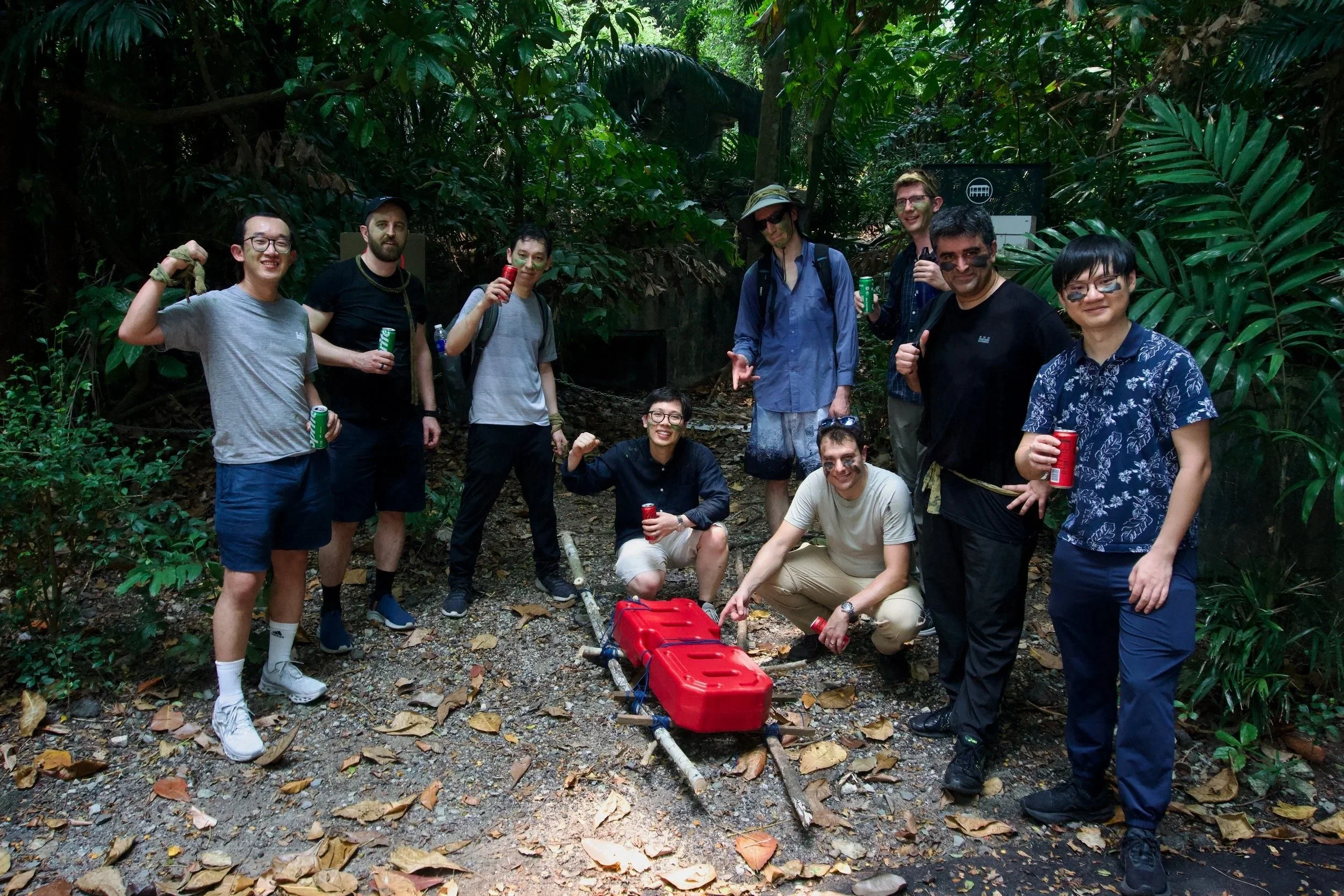
Nine People. 40 Points. Two Hours to Hold the Fort: Citadel Securities at Fort Serapong
Nobody was trying to beat another team.
There wasn’t another team.
For two hours at Fort Serapong, nine people from Citadel Securities had one scoreboard, one clock and one shared problem: keep the fort operational.
The mission had originally been built for ten. Nine stepped into Serapong on the day. The clock, the points and the problems stayed exactly the same.
There were 40 points available. They needed 31.
Finish early, and another five points were on the table.
That was about as much certainty as we wanted them to have.
Because this small group team building experience in Singapore was never designed as a collection of unrelated games.
One decision would affect the next.
Equipment picked up early could become important much later. Information would arrive before the team necessarily understood why it mattered. Some choices would earn points immediately. Others would give them nothing at all, until suddenly they mattered.
And somewhere along the way, nine colleagues would have to start operating like one unit.
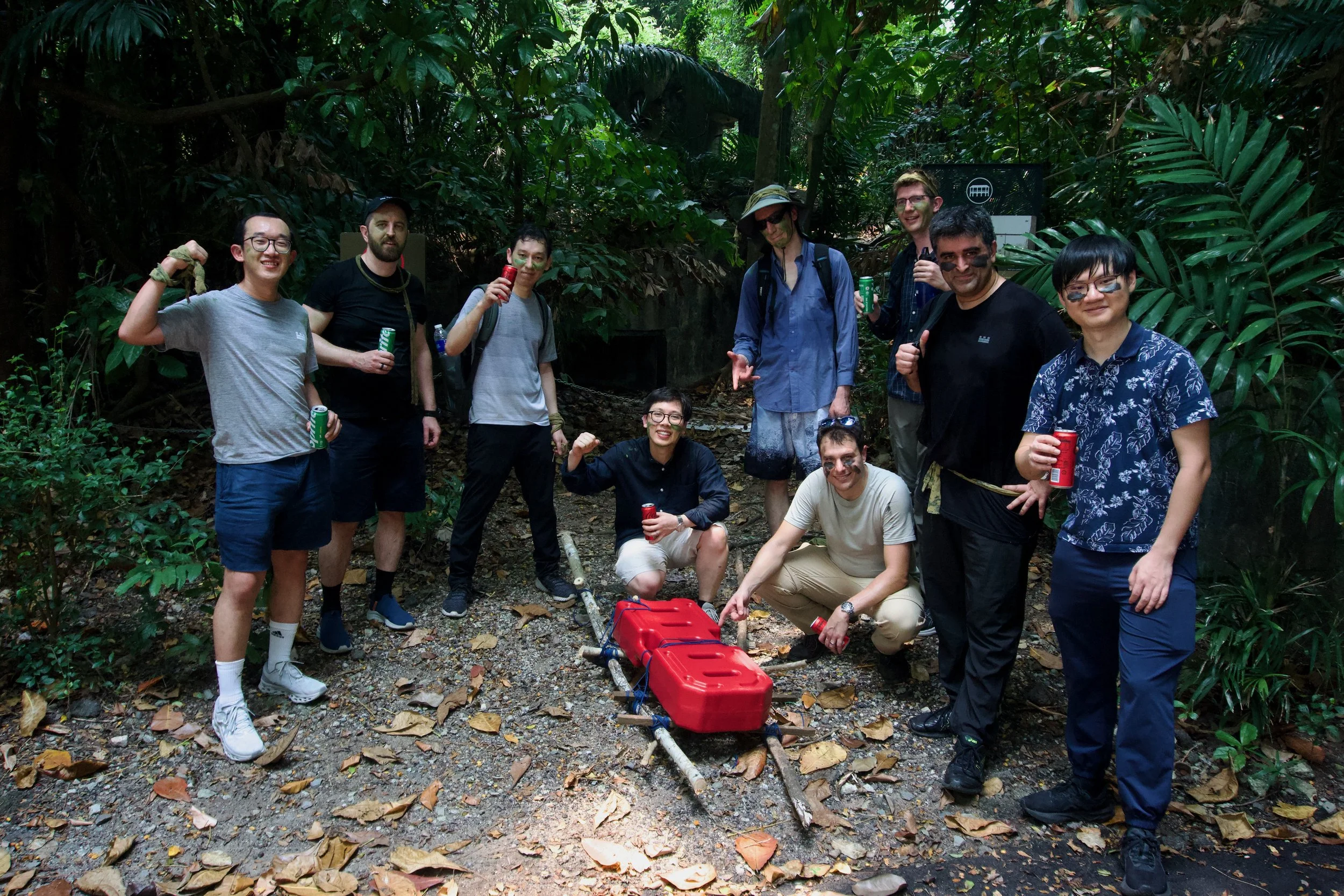
Two hours earlier, none of this existed. Not the stretcher, not the route, not the shorthand.
Mission Board
The team would move through blind infiltration, resource recovery, fire and water, shelter construction and a final improvised transport mission, with earlier choices carrying consequences into later stages.
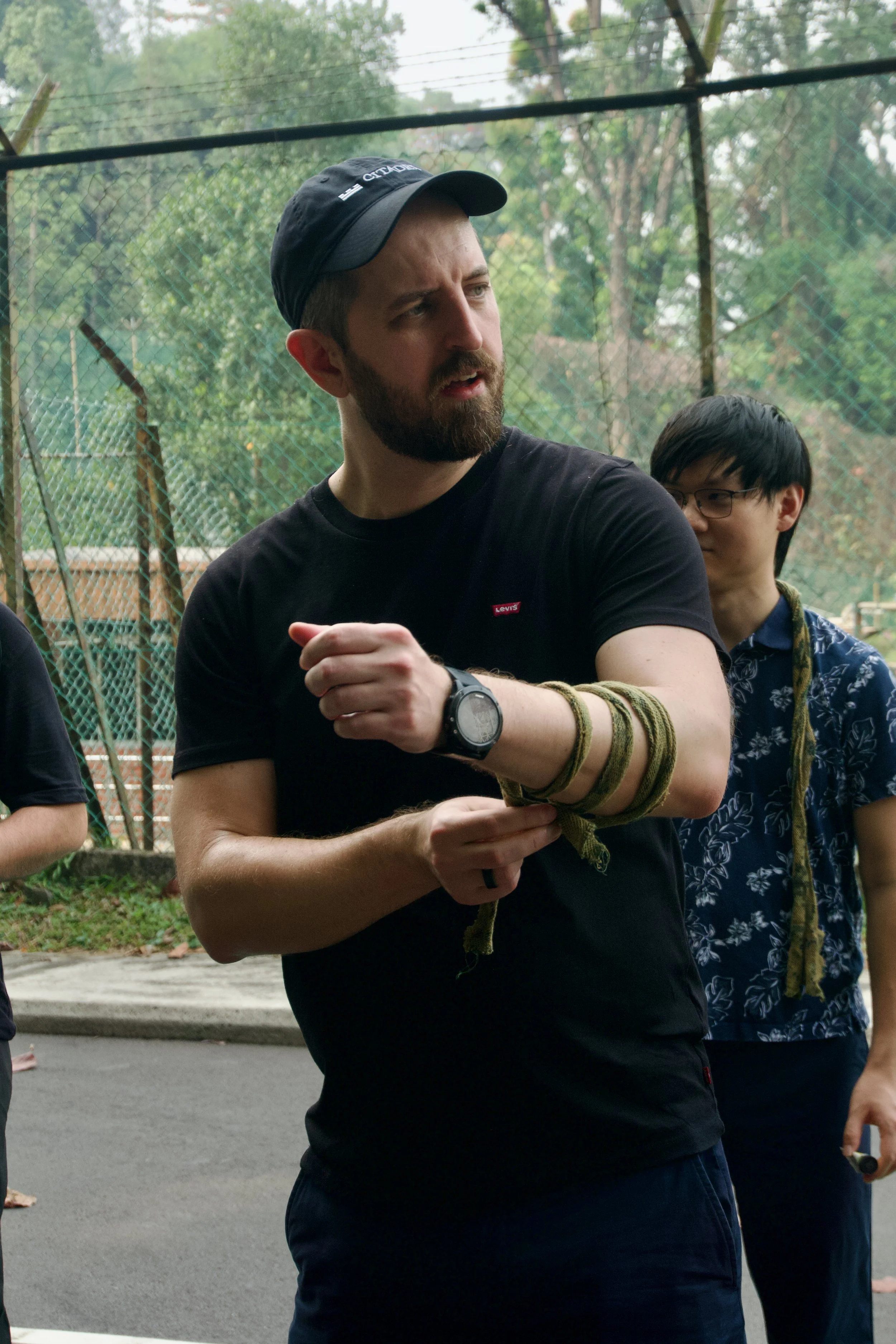
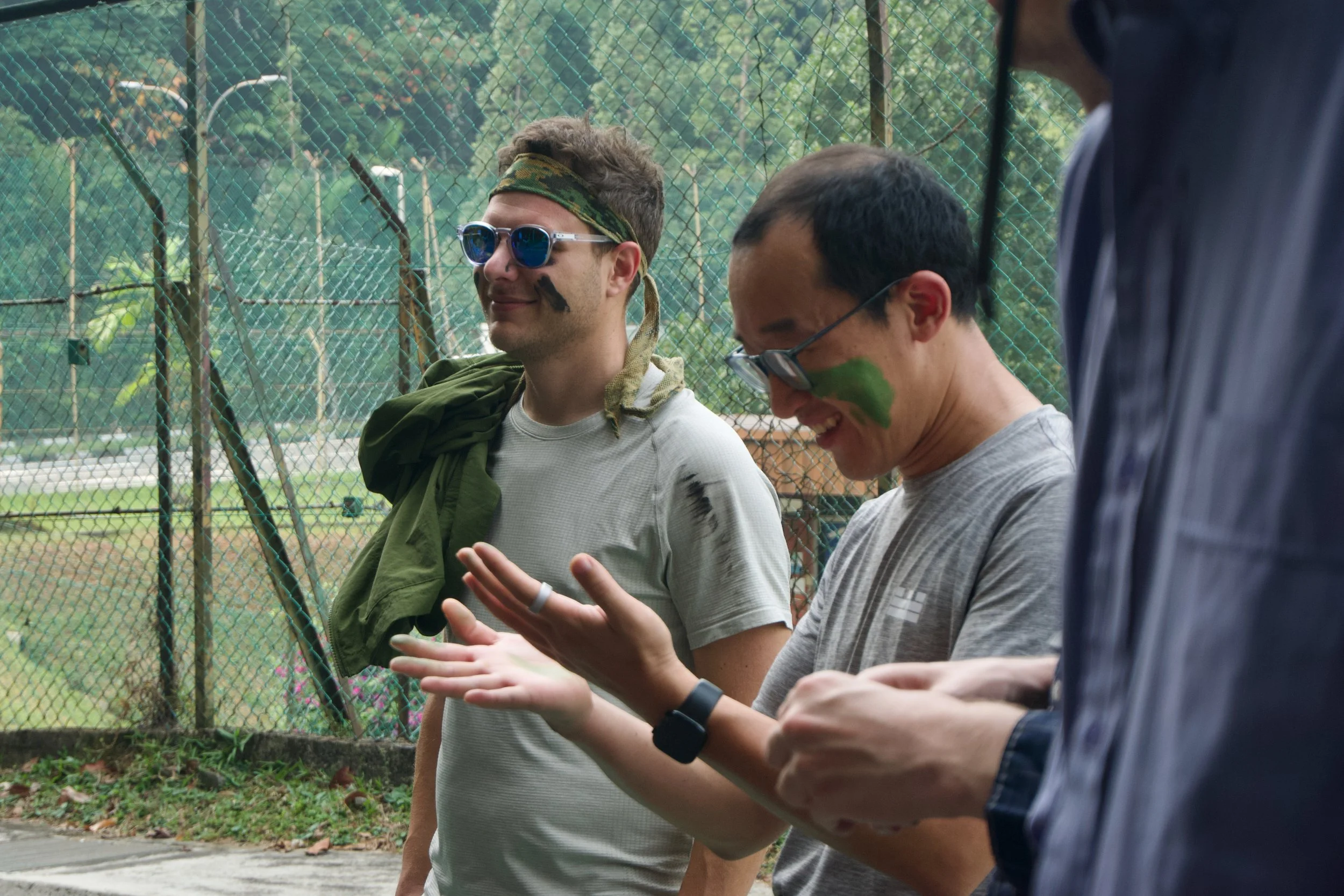
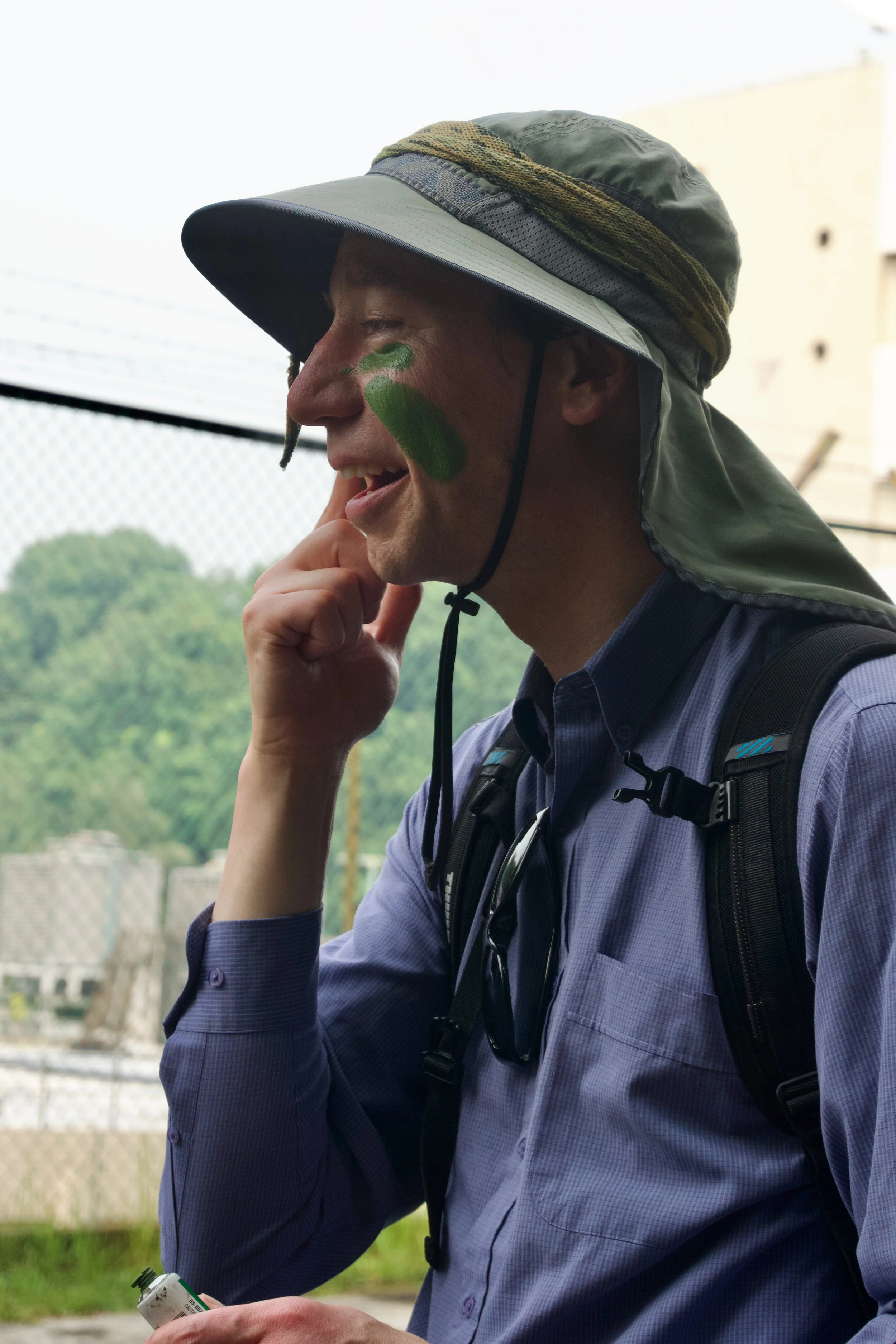
Camouflage cream, applied with varying degrees of technique and commitment.
00:00. Civilian mode ends here.
At the entrance to Fort Serapong, they were still nine people from Citadel Securities.
We wanted that version of the group to stay outside.
Camouflage went on. A Unit Commander was appointed. Then a 2IC.
The Commander carried the radio.
From that point, information from “Serapong Command” would reach the group through them, and every decision had to travel the other way.
It sounds theatrical.
It was supposed to.
A good outdoor team experience needs enough story for people to stop thinking about the fact that they are participating in a corporate programme.
The moment the fiction starts working, job titles matter a little less.
The problem in front of you matters more.
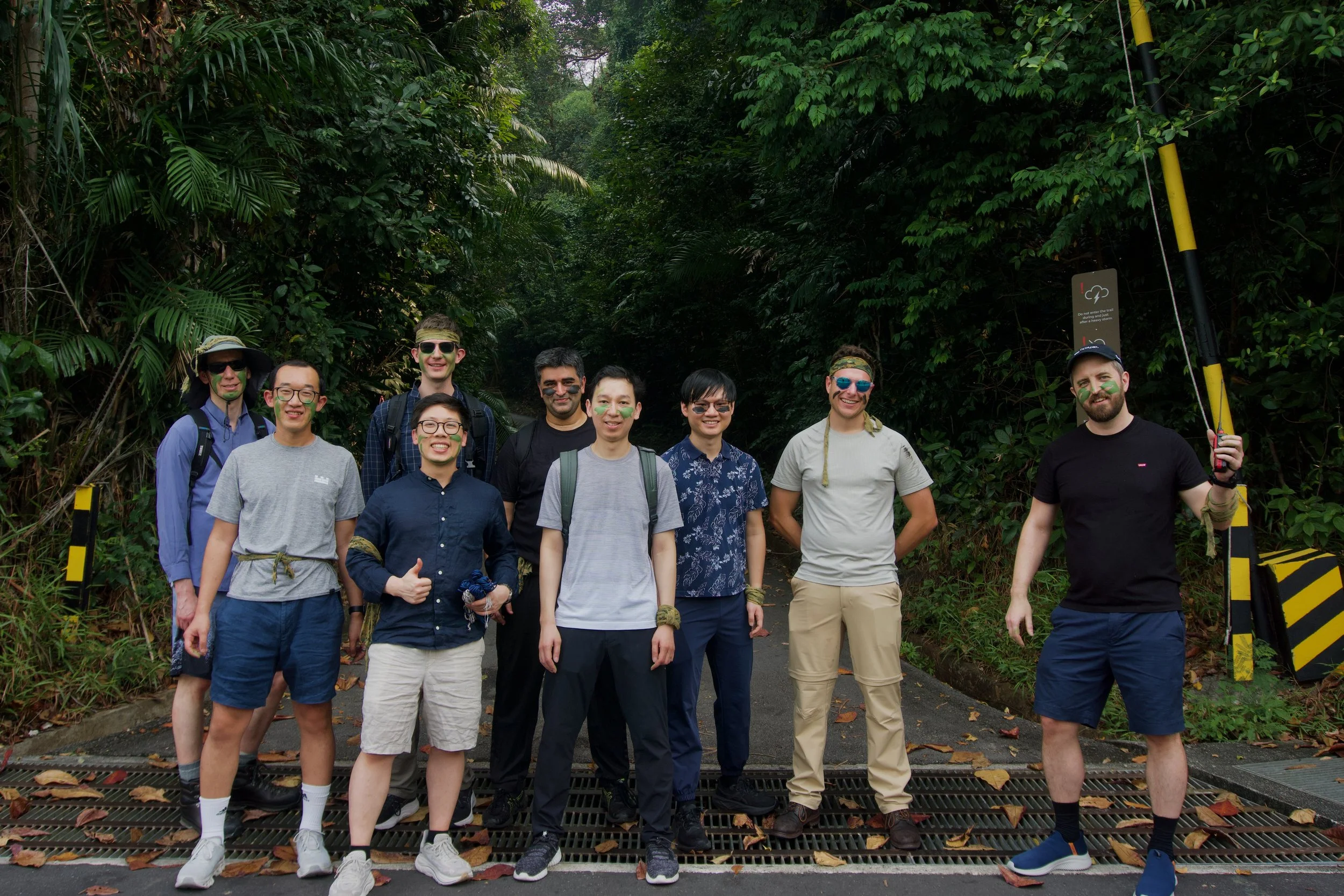
Nine colleagues at the gate, face paint on, still fairly confident about the next two hours.
And then we took away their eyesight.
Mission 01
Move before you can see
Everybody was blindfolded.
Including the Commander.
The normal route into Serapong was “compromised”, so the unit had to enter through unfamiliar terrain and reach Spur Battery together.
Nobody could be left behind.
We stayed close enough to manage safety. Everything else belonged to them.
A change in terrain had to travel down the line. A branch, step or obstacle discovered by the first few people needed to somehow become useful information for everyone behind them.
At the same time, intelligence questions were being sent to the group. The Commander had to process the answers and lock in the team’s final decision while everyone kept moving.
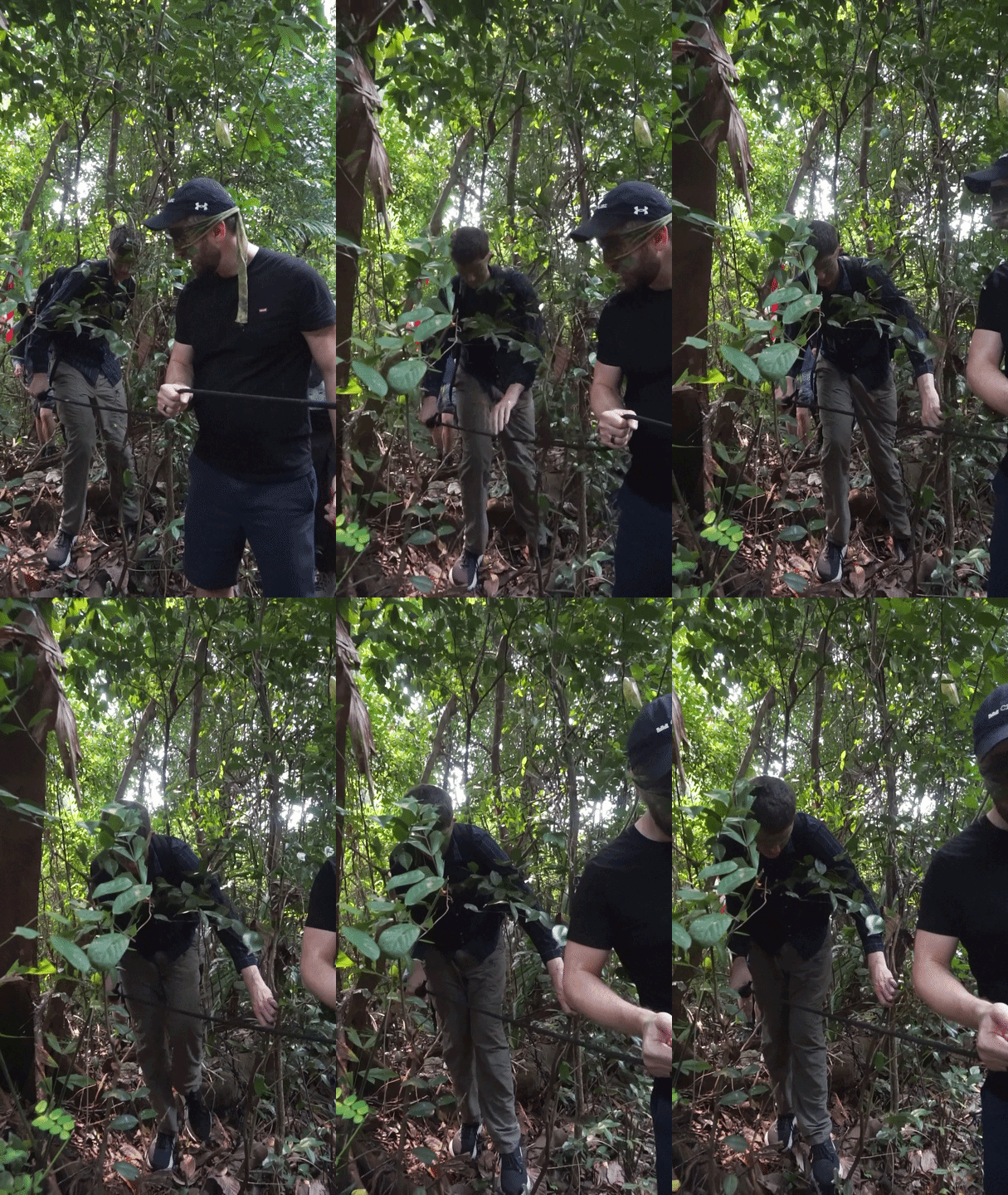
One person’s discovery only counted if it reached the back of the line.
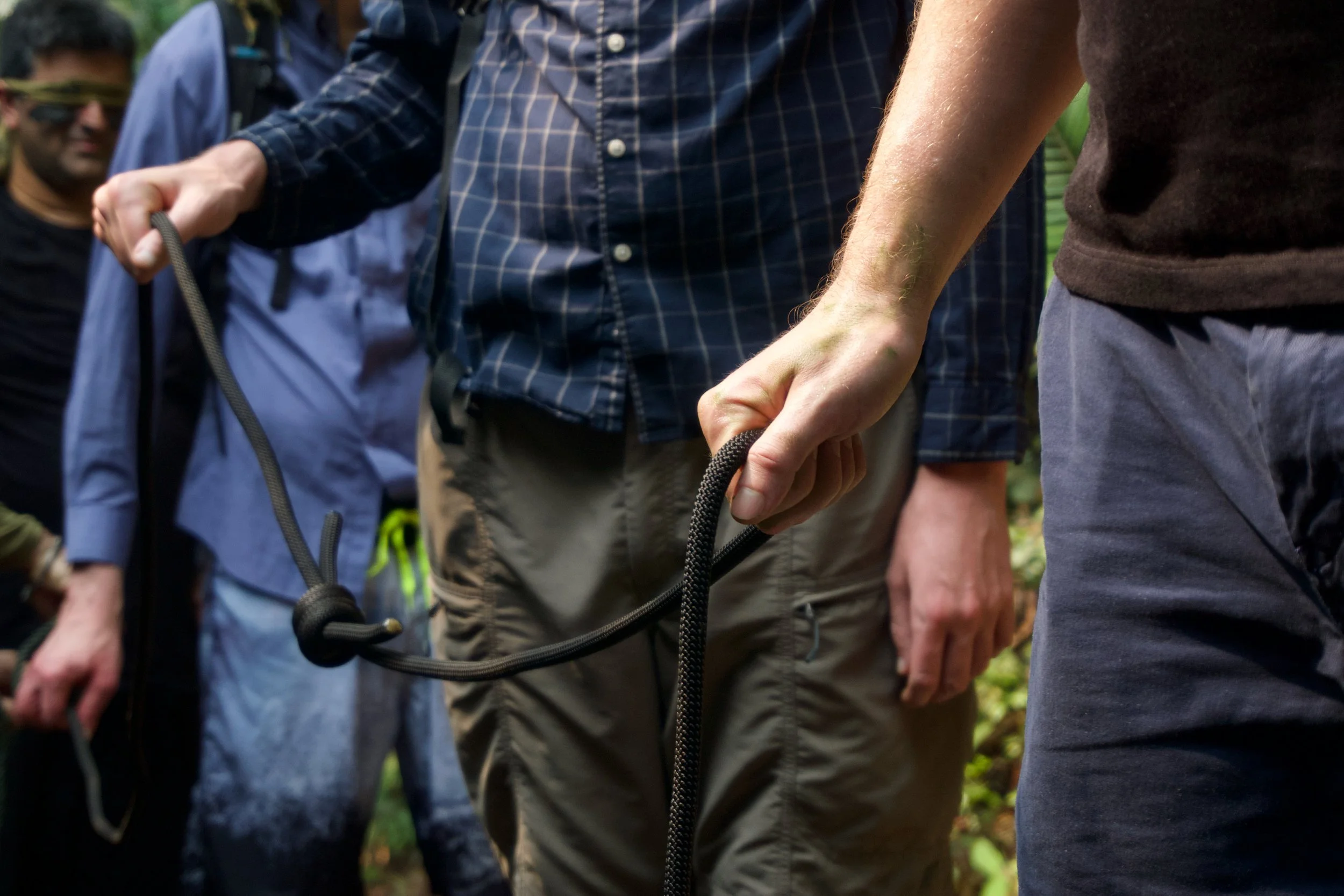
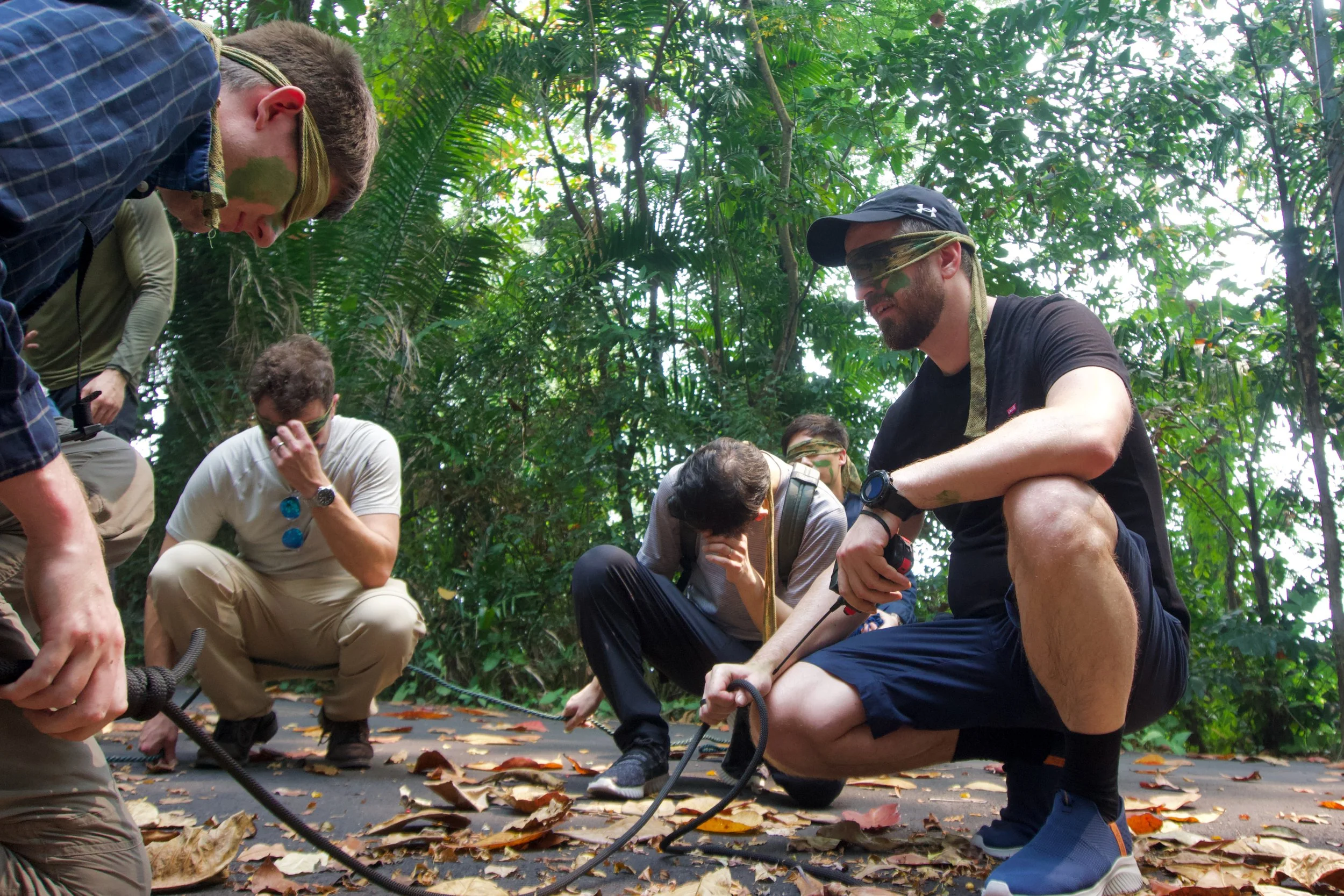
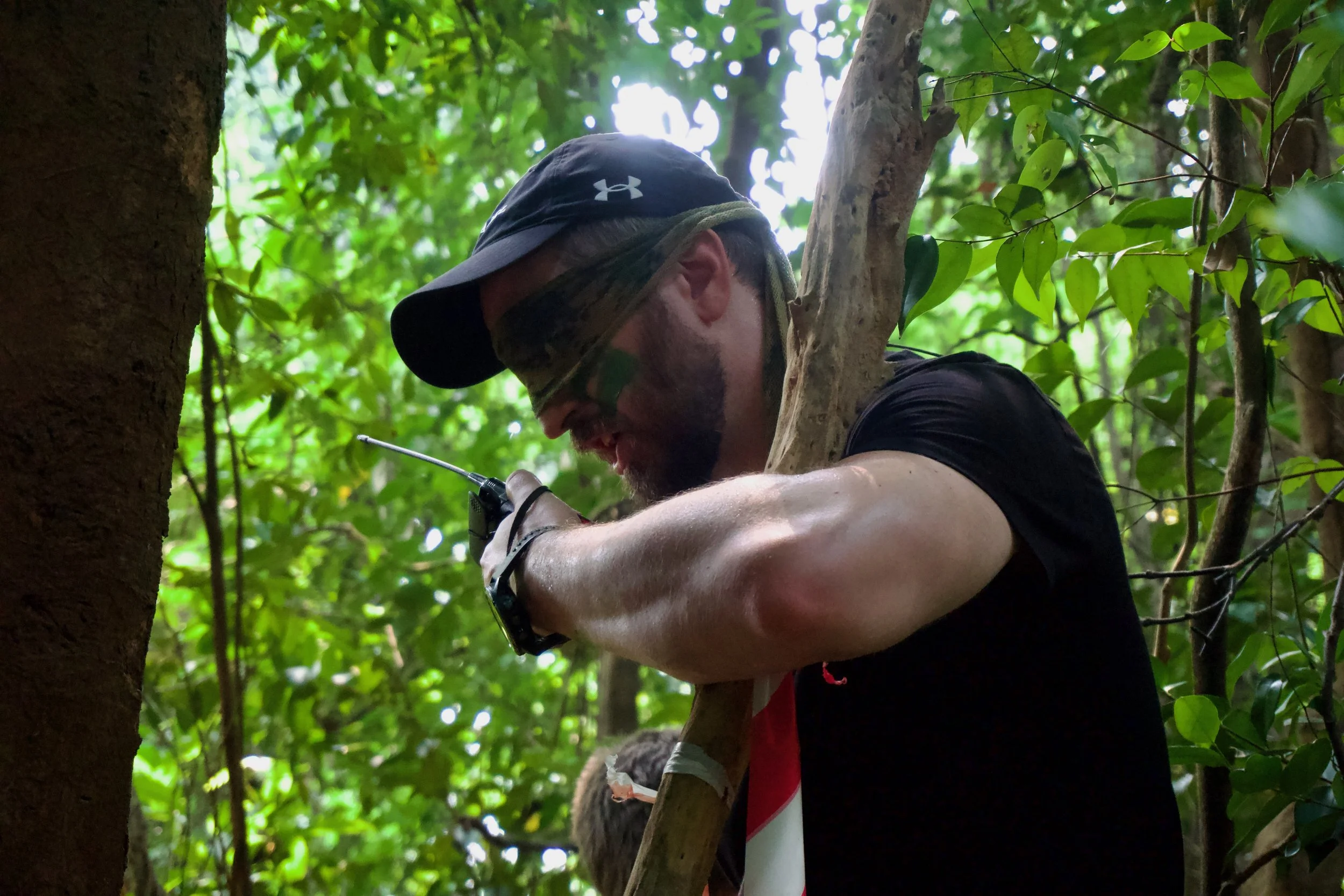
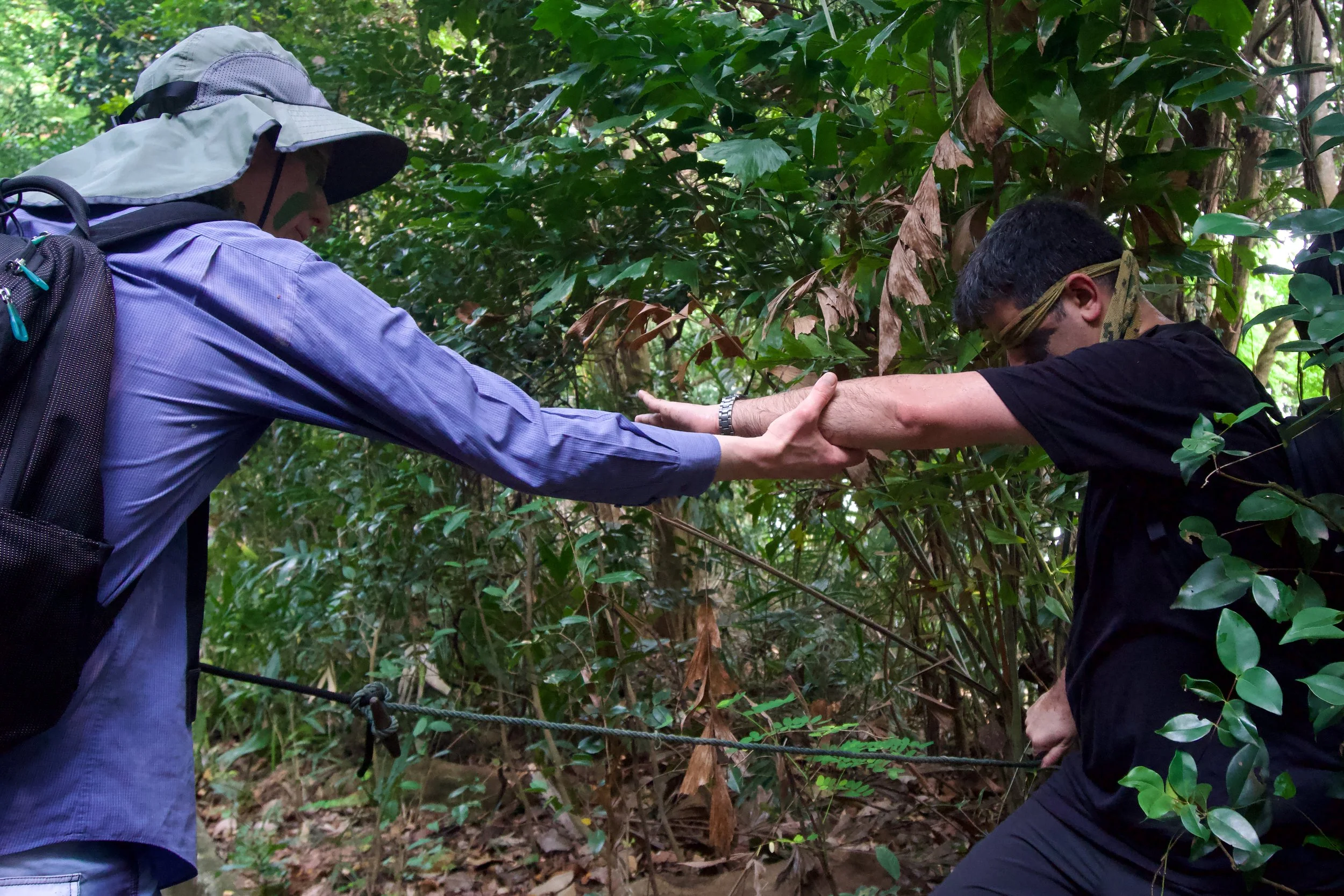
One rope, nine pairs of hands, and no view of whatever was coming next.
This was probably the fastest point in the programme where the usual idea of “team communication” stopped being abstract.
If an instruction was vague, somebody felt it.
If useful information stopped halfway down the line, somebody felt that too.
There was no PowerPoint slide about communication styles.
There was just a tree.
And somebody was about to walk into it.
First position secured
Eventually the group reached Spur Battery.
Blindfolds came off.
Water, bananas and energy bars came out.
For a few minutes, everything became easier.
That was deliberate too.
Because the next challenge would introduce a different problem entirely.
They had just spent twenty minutes with too little information.
Now we gave them too much choice.
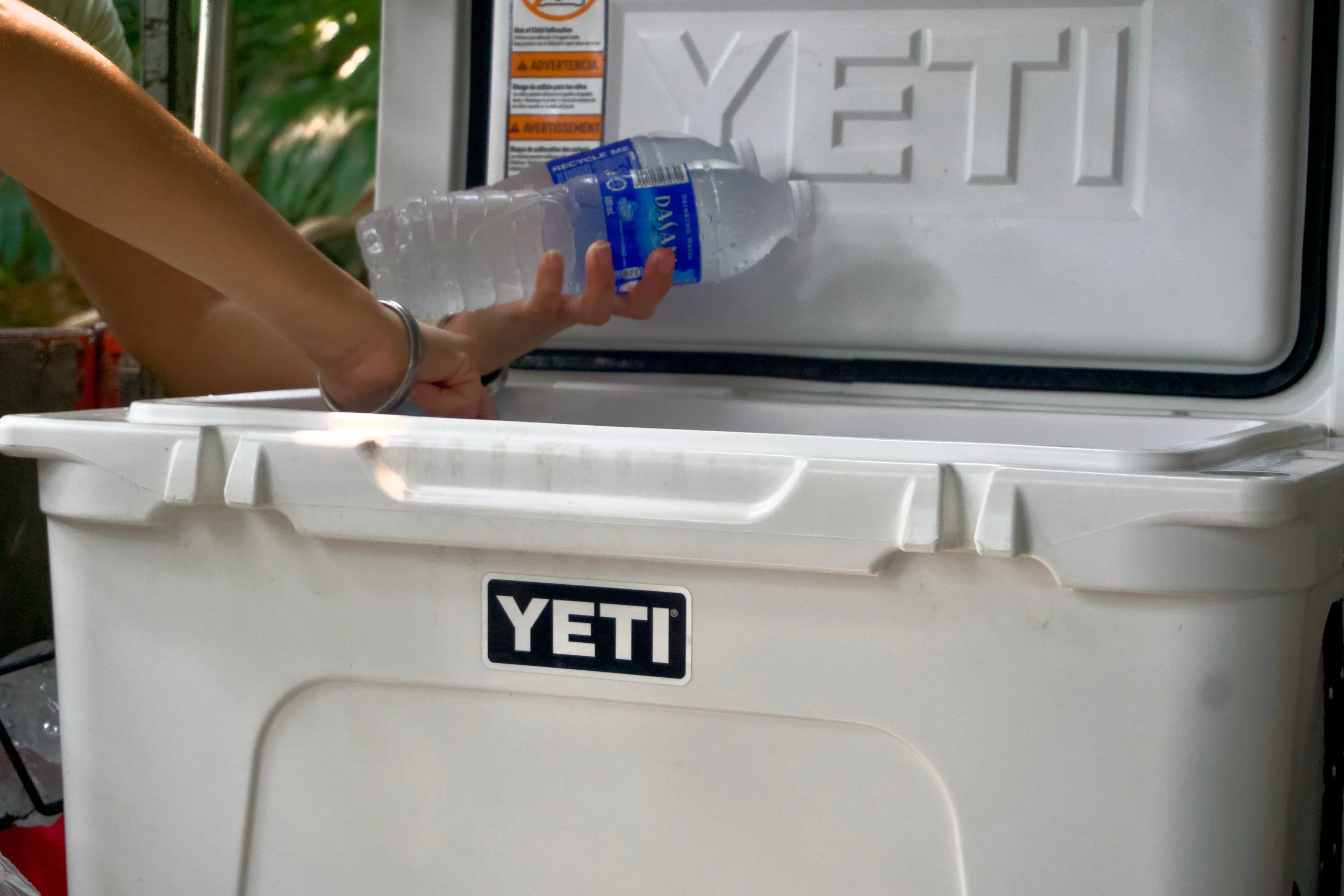
Blindfolds off, cooler open. The reward for arriving lasted about four minutes.
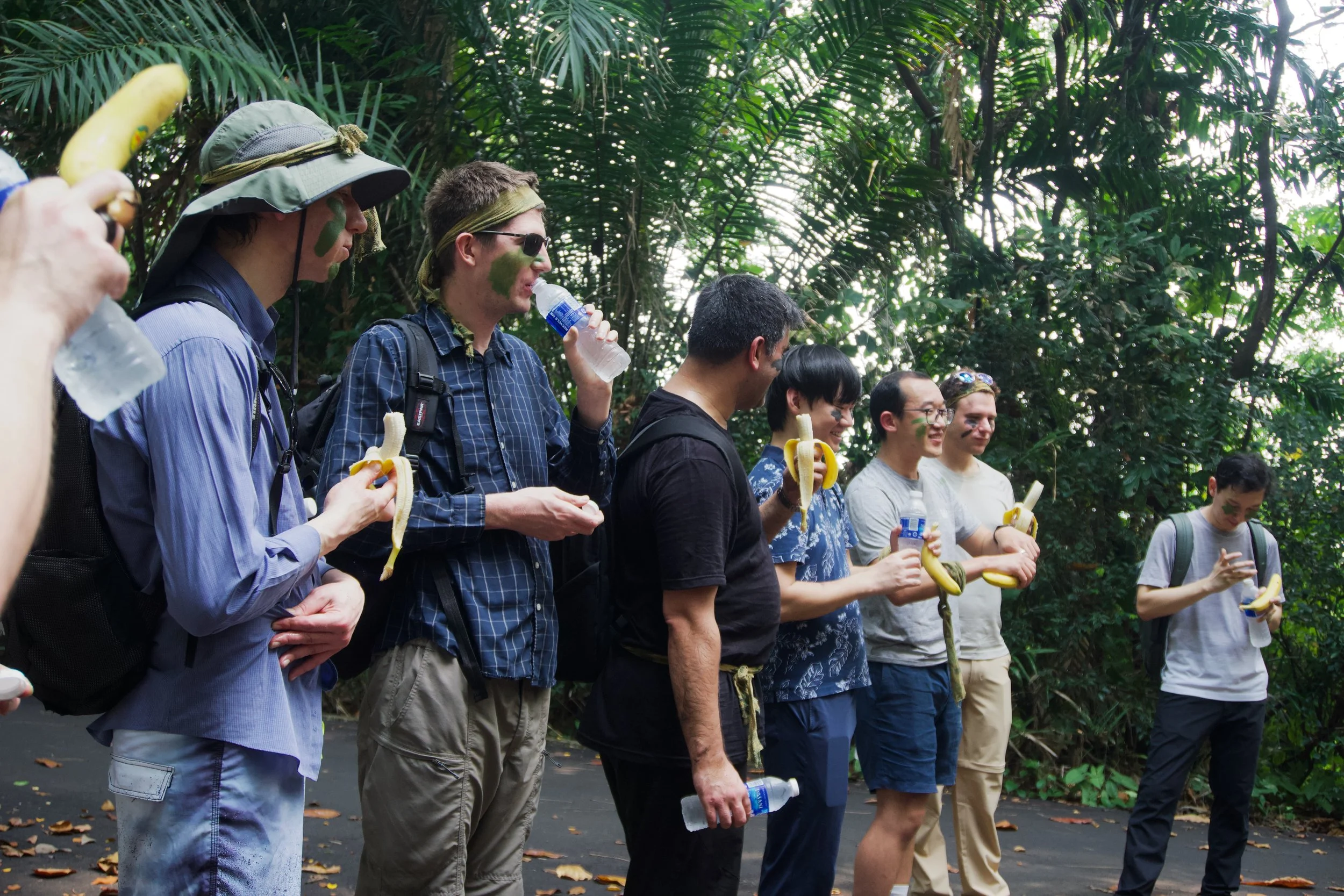
Bananas, water and a few minutes of calm before the Casemate complicated things.
Mission 02
Take what you think you’ll need
Inside an old Casemate, resources had been placed across several compartments.
The team received five minutes.
There was no shopping list.
We would not tell them what came next.
They simply had to decide what might be useful, carry whatever they selected, and leave the rest behind.
Anything abandoned stayed abandoned.
If they discovered forty minutes later that they needed it, going back would cost them time.
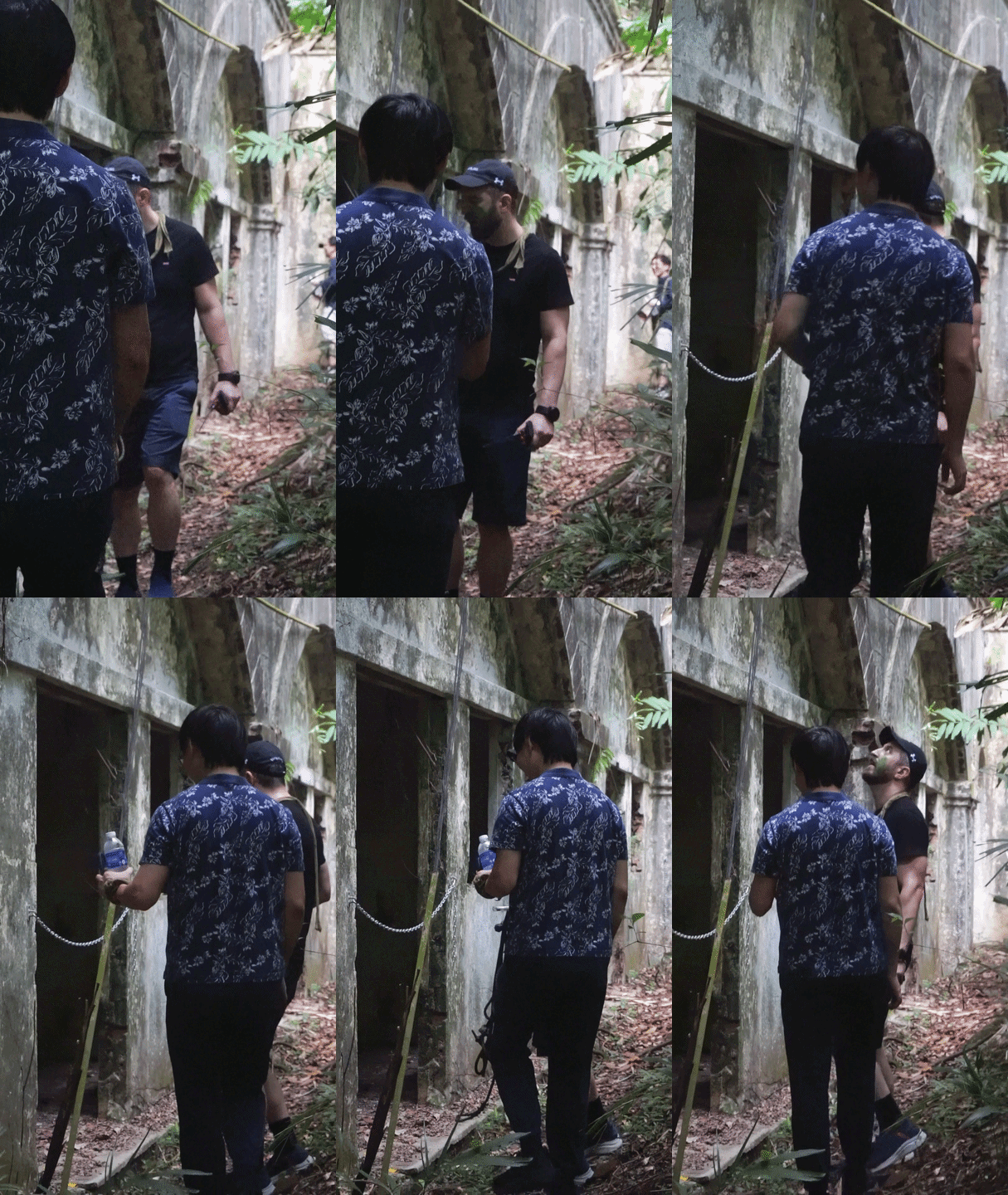
Five minutes, several compartments and no list of what actually mattered.
There were no points available here.
And that was the interesting bit.
Not every important decision gives you an immediate reward.
Sometimes you make a call because the information you have right now suggests it is the best one available.
Then you keep moving.
For a small team, this format becomes particularly interesting because there is nowhere for participation to disappear.
In a group this small, one person hesitating changes the rhythm. One person spotting something useful matters. One person carrying equipment others ignored can become important later.
Everyone stays visible.
That is a very different dynamic from dividing 80 people into teams and sending them around an activity circuit.
Leave the concrete behind
The next clue sent them away from the military structures.
Higher ground.
Rock.
Granite.
When the terrain felt less like a fort and more like the wild, they were getting close.
At Granite Hill, the next message arrived.
The unit needed safe water, heat and food before it could continue.
Now the things they had chosen at the Casemate were no longer random objects.
They were resources.
Mission 03
Fire first. Then everything else.
Twenty minutes.
Build fire.
Bring water to a proper boil.
Get the unit operational again.
There were ten points on the table.
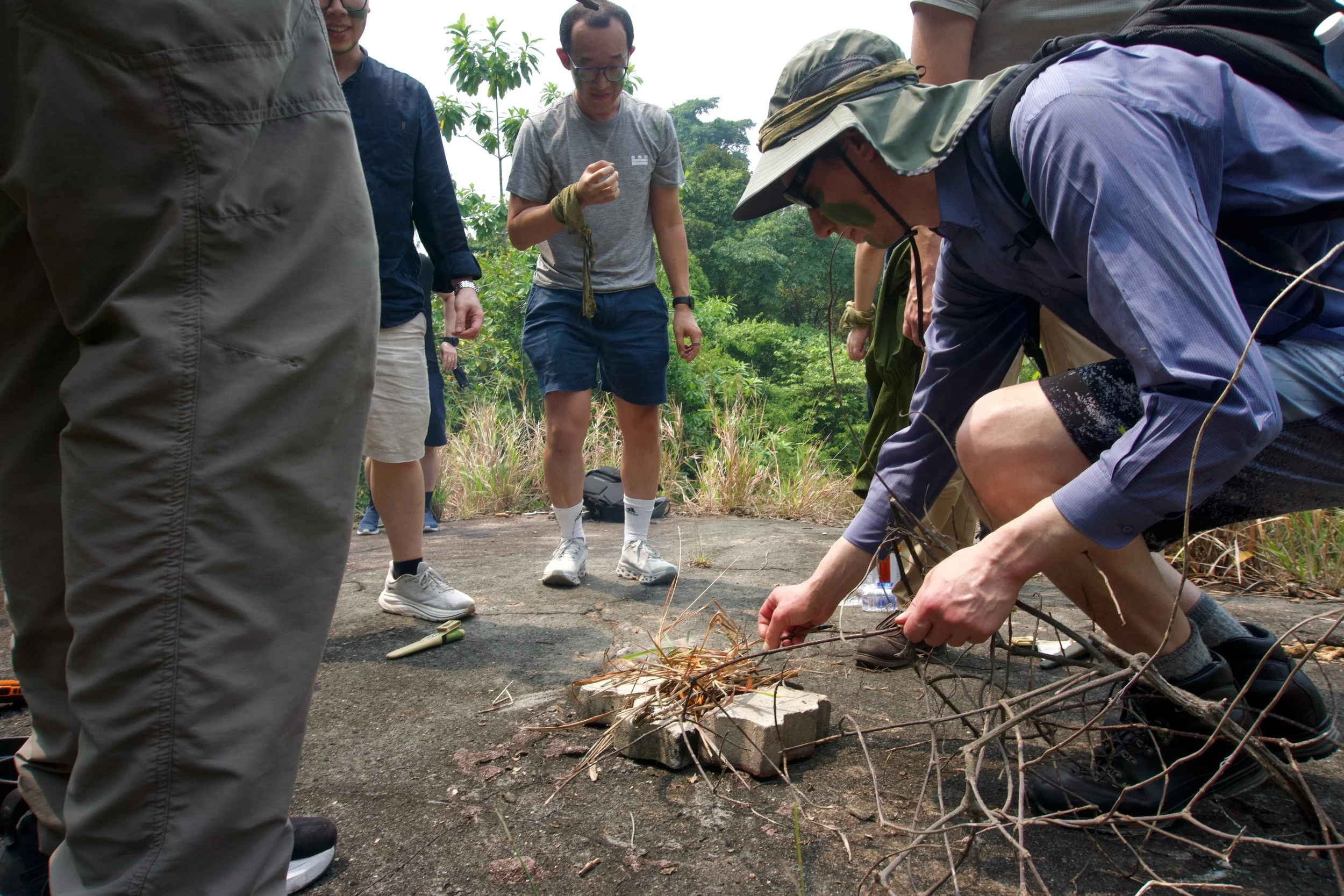
The Casemate choices stopped being abstract the moment someone had to make a flame.
The footage from this part of the afternoon is some of our favourite.
Not because everything looks polished.
Quite the opposite.
People are crouched down around the fire.
Hands keep appearing from different directions.
Smoke is everywhere.
Somebody is working on tinder. Somebody else is dealing with fuel. Someone is watching the pot. Others are bringing material in.
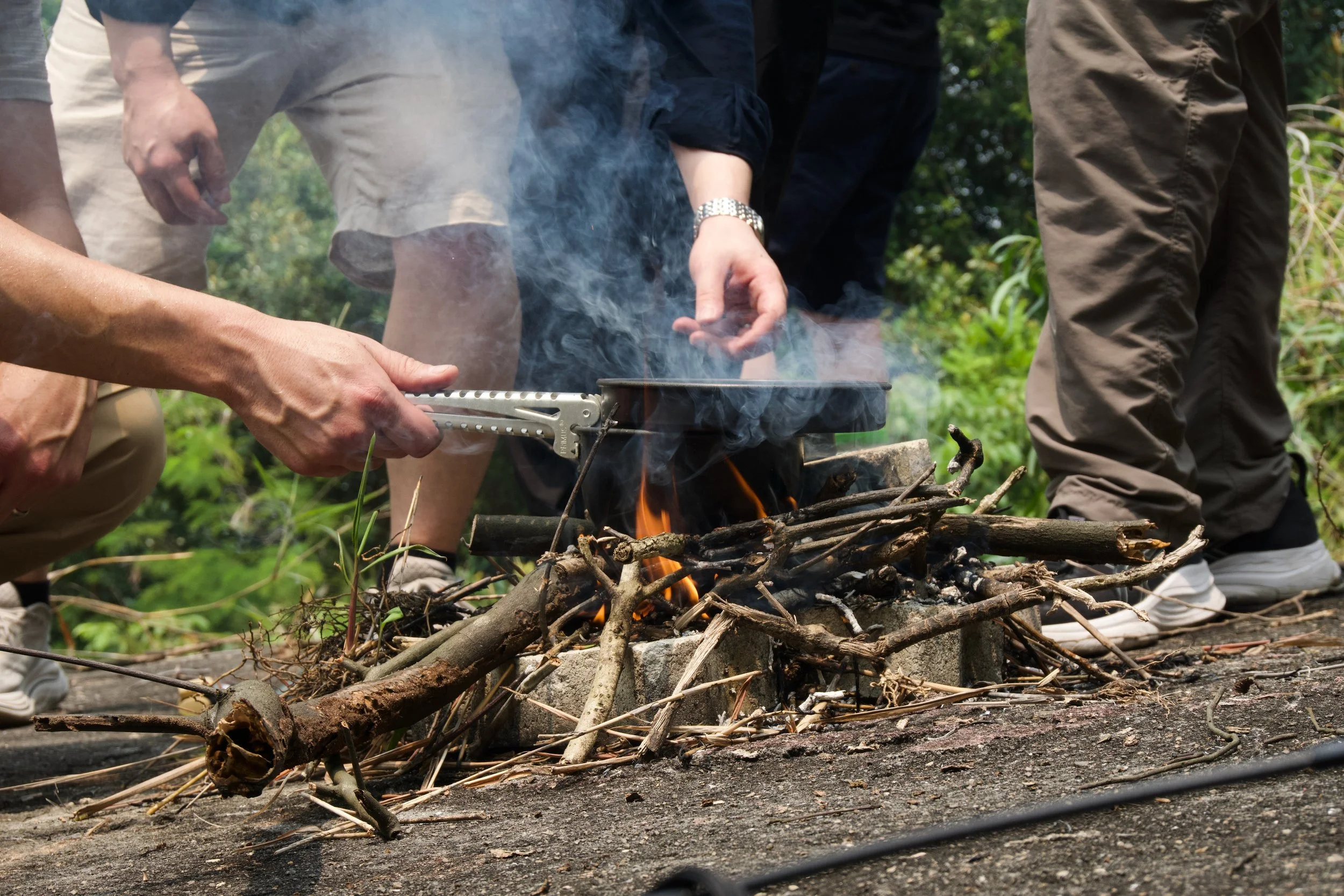
Lighting it was one problem. Keeping it useful long enough to boil water was another.
This is why we use practical tasks in our corporate team bonding programmes.
Starting a fire is not the corporate lesson.
Boiling water is not the corporate lesson either.
The interesting part is everything that starts happening around the task.
Everyone has the same outcome.
Who notices what needs doing?
Who waits for instructions?
Who starts organising?
Who solves a small problem before it becomes a big one?
Who changes approach when the first idea does not work?
You do not need to manufacture those conversations.
Give a team a problem with a real consequence and they tend to appear by themselves.
Once the water boiled, noodles were released.
Mission 04
Just when they thought they could eat
The fire was going.
The water was boiling.
For a brief moment, Granite Hill felt under control.
Then we changed the problem.
Before the team could properly settle into their hard-earned break, Serapong Command delivered another update: the position was no longer considered secure.
They now needed shelter.
Not later.
Here. Now.
That was deliberate.
We wanted to see what happened when a team had already committed its attention and energy to one problem, only to have another arrive before the first one had completely disappeared.
There was no neat reset between activities.
No walking to the next station while everyone mentally started again.
The clock was still running, the fire still needed attention, equipment was already spread across Granite Hill, and suddenly the group had another problem competing for people and resources.
Their objective was to build a functional natural shelter using the materials around them and whatever useful equipment they had carried forward.
It had to stand.
It had to provide meaningful protection.
And it had to meet the capacity requirement we gave them.
Twenty minutes.
Ten more points.
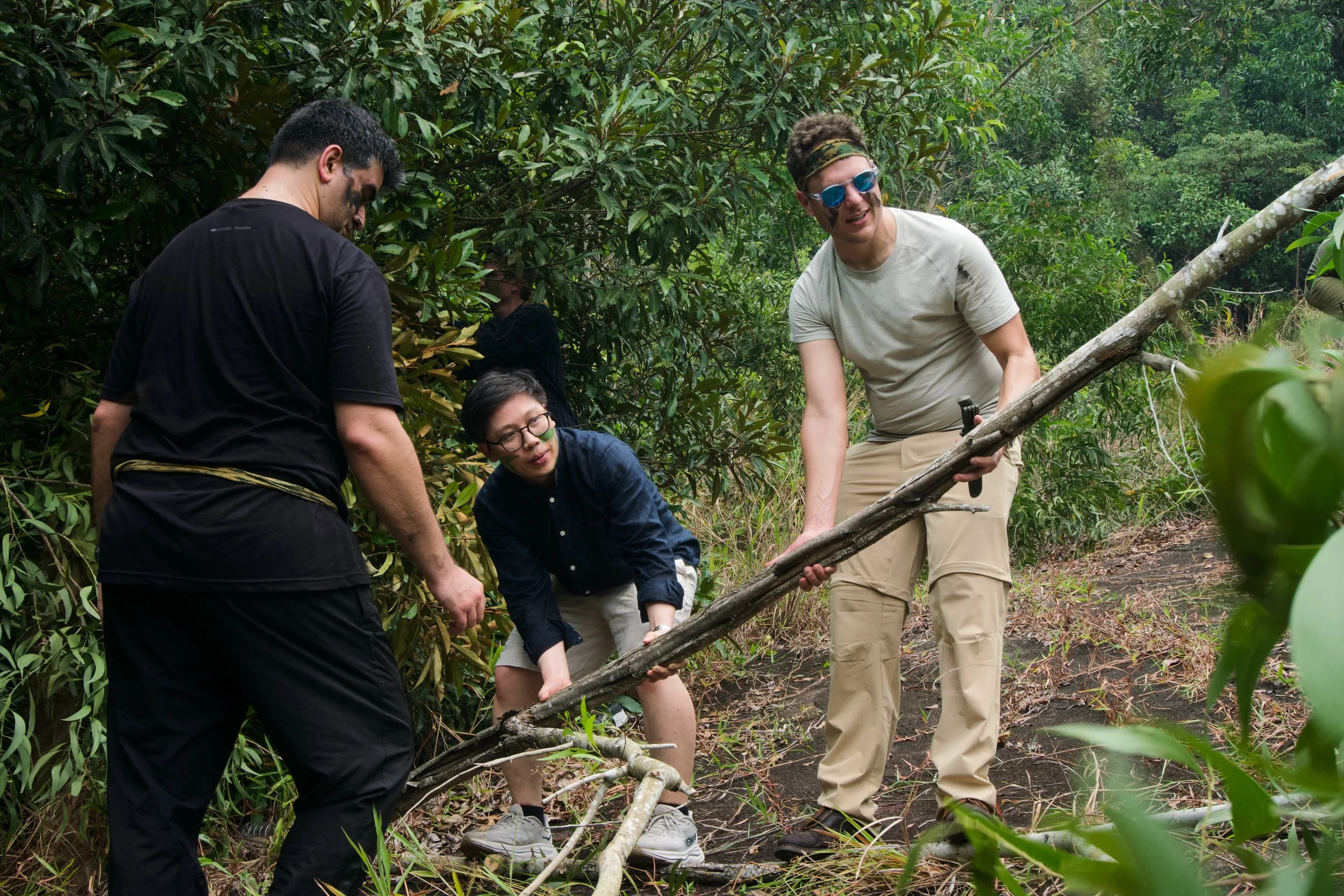
No reset. The fire was still burning while the search for usable branches began.
This was where the mission became less about completing one task after another and more about managing several things at once.
Some people stayed close to the fire.
Others started looking for suitable branches and materials.
The rest had to work out how to turn what they found into something that could actually hold together.
Nothing like being halfway through lunch preparations and being told you now need to build a roof. 😂
By this stage, the group had already dealt with blind movement, uncertain information, resource choices and fire.
Now we were testing something slightly different:
How quickly can you reorganise when the situation changes without warning?
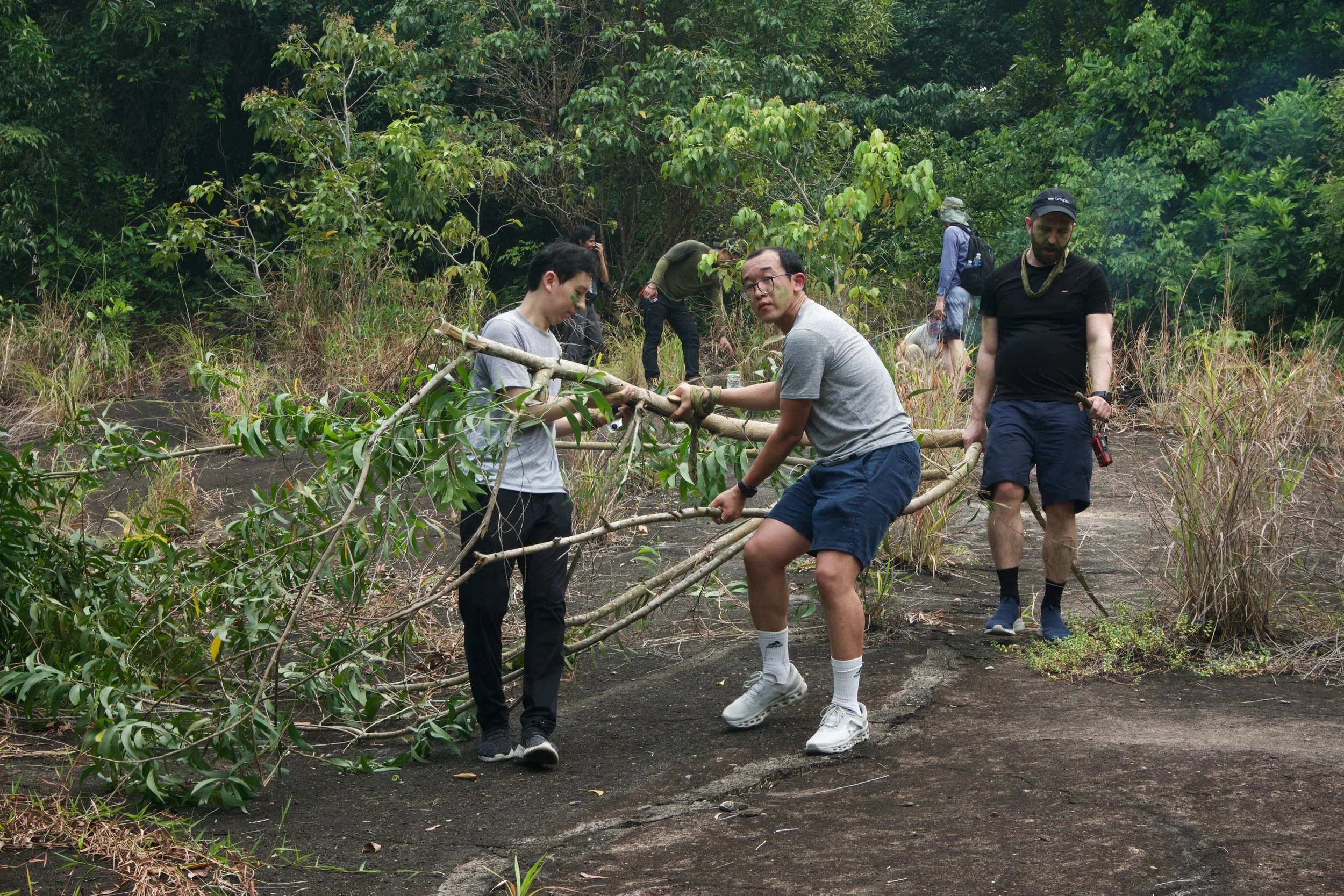
Twenty minutes to turn whatever Granite Hill offered into something that could stand.
The shelter did not need to look pretty.
It needed to work.
And when time was called, everyone stepped back.
Because at Serapong, an idea does not earn the points. The structure does.
And just when Granite Hill finally looked reasonably operational, the radio came alive again.
Spur Battery had another problem.
This one involved 30 litres of fuel.
And getting it back was going to require more than carrying it by hand.
Mission 05
Thirty litres changes the problem
Somewhere in the next sector was a 30-litre fuel load.
The team had to find it and return the full load to Spur Battery.
Except there was a catch.
They could not simply pick it up and carry it.
They first had to build an improvised field stretcher capable of transporting it through the terrain.
Twenty minutes covered everything.
Find the load.
Plan.
Build.
Test.
Load it.
Move.
This was where the architecture of the entire mission finally revealed itself.
The resources chosen earlier mattered.
The materials they still had mattered.
Knots mattered.
Communication mattered.
Time definitely mattered.
A beautiful stretcher sitting on the forest floor meant absolutely nothing. Thirty litres was going on it.
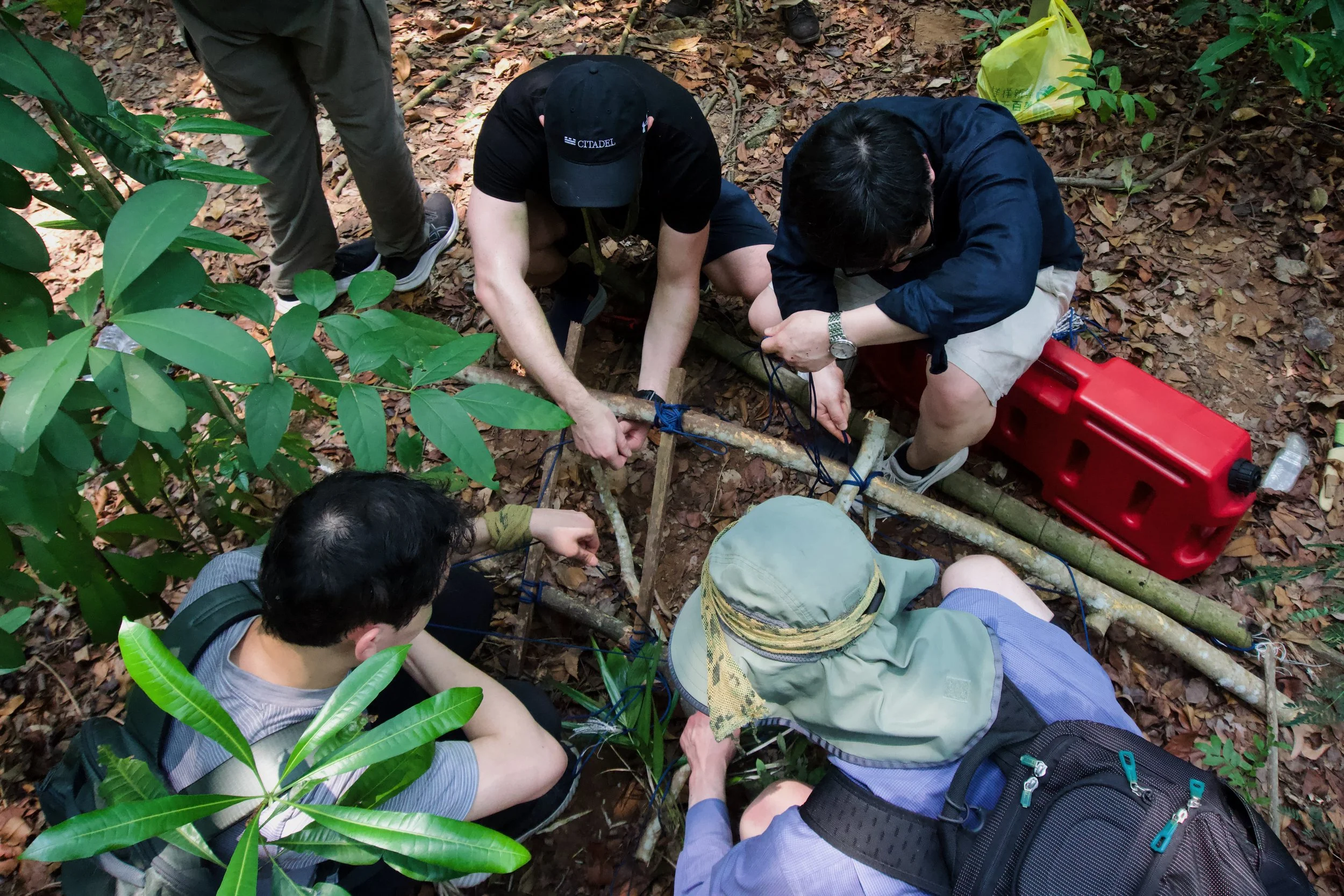
Heads down over rope and poles, with the red load already waiting beside them.
Hands went onto rope.
Poles were positioned.
Lashings tightened.
People tested and adjusted.
Then the red load went on.
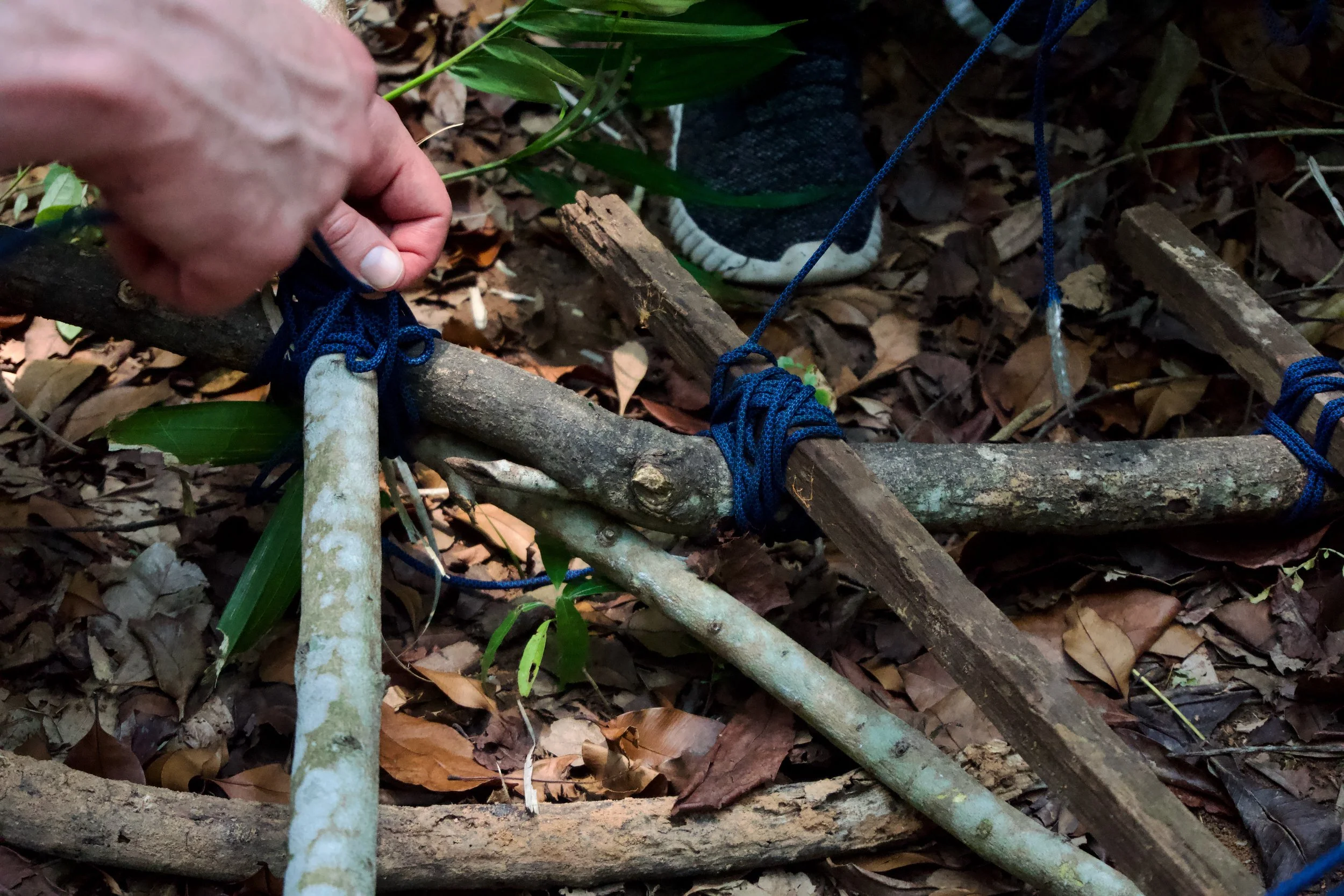
The kind of detail nobody thinks about until thirty litres is resting on it.
And finally, the whole thing had to move.
One load. No spectators.
The final stretch is probably where this particular small-group team building format makes the most sense.
When nine people are carrying one problem through uneven ground, the concept of participation becomes very simple.
You are either helping the system work or the system notices.
Nobody can hide in the back row.
Nobody can quietly let another team earn the points.
There is no other team.
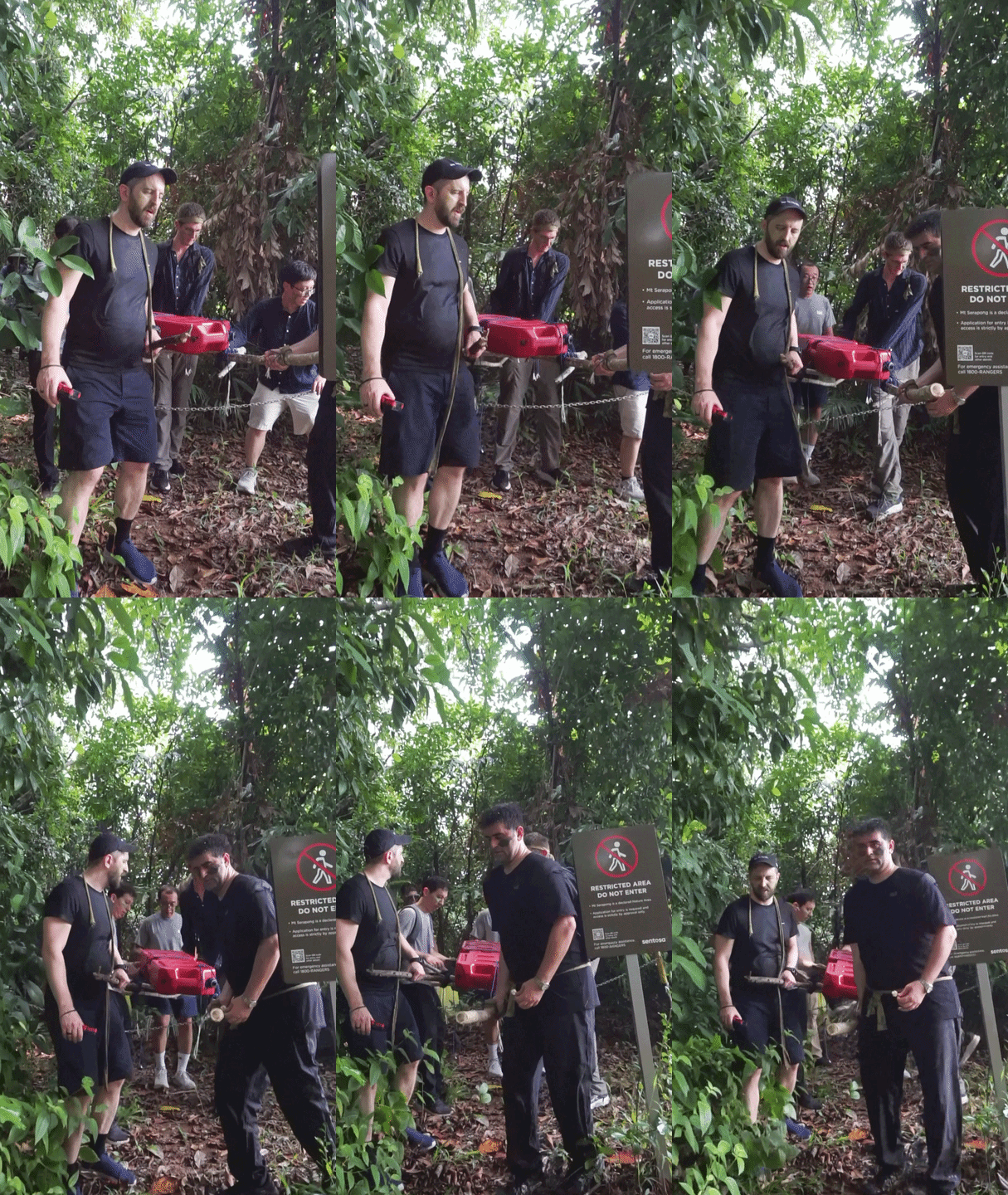
The load goes on, and the whole thing stops being a theory.
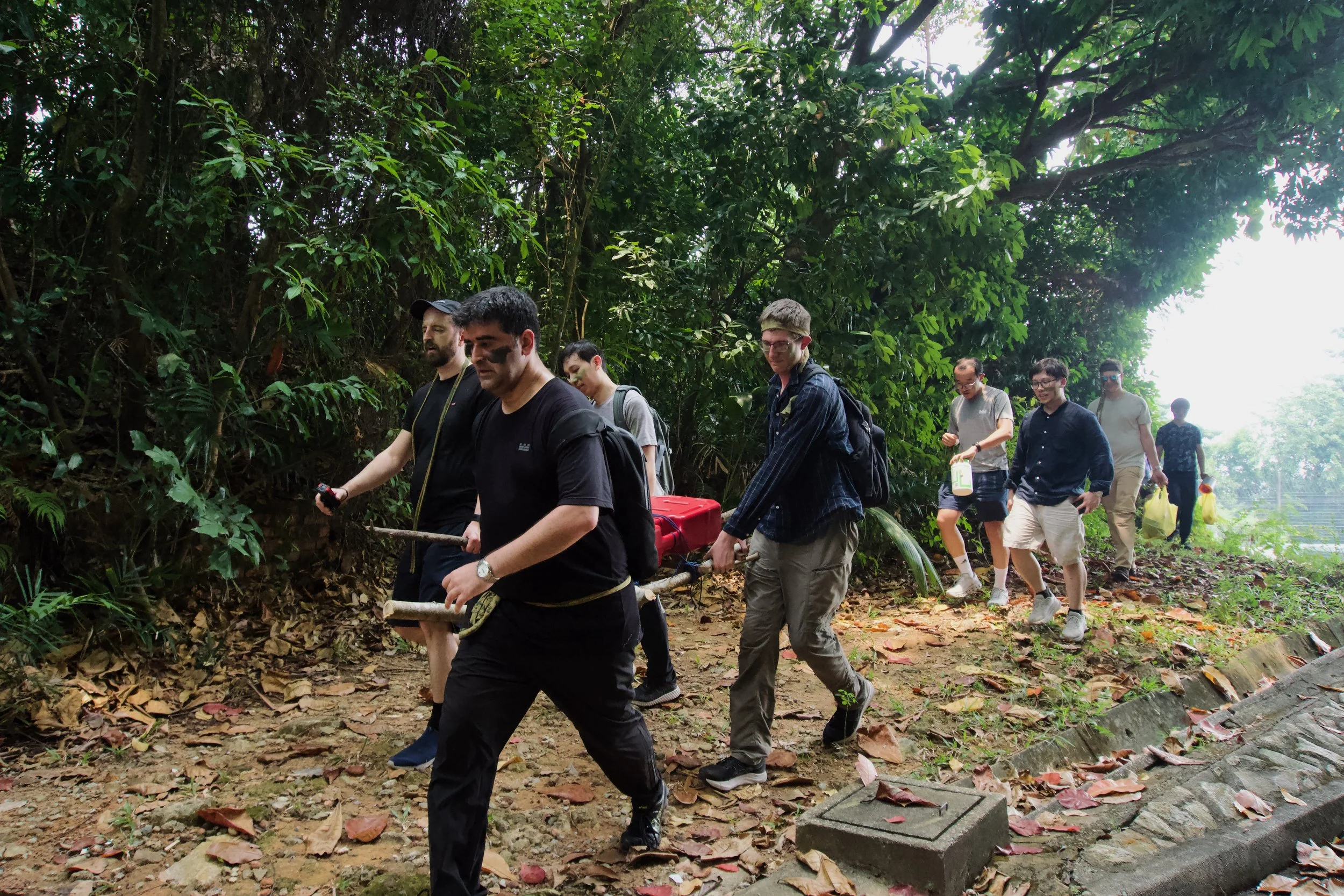
Same terrain they had entered blind, now crossed with something they had built themselves.
Earlier in the day, the group had been walking into Serapong blind.
Now they were moving together with a load they had found, a transport system they had built and a deadline that was disappearing in real time.
That change is the story.
Not who tied the best knot.
Not who started the fire.
Not even the final number written on the scoreboard.
It was how quickly nine separate people began working around the same problem.
The best part? There was nobody to beat.
Most team building programmes instinctively create competition.
Blue team versus red team.
Department versus department.
Fastest time wins.
There is nothing wrong with that. Competition can create great energy.
But it was not what we wanted here.
Citadel Securities operated as one unit from beginning to end.
Their competition was the clock, the terrain and whatever problem Serapong handed them next.
That changed the behaviour of the experience.
A strong person helping somebody else did not weaken their own team’s chances.
Useful information did not need to be hidden.
Resources did not belong to one group.
When something failed, everyone inherited the problem.
When something worked, everyone moved forward.
That design decision was intentional.
In the final debrief, the experience came back to a few very simple ideas:
Information arrives.
Teams decide what matters.
Decisions are sometimes made before perfect certainty exists.
Resources are limited.
Conditions change.
And eventually, the system still has to work.
Different environment from the workplace.
Very different stakes.
But an interesting way to watch a team solve problems together.
Why small-group team building needs a different design
A small team should not automatically receive a smaller version of an activity designed for one hundred.
Small groups have a different advantage.
Everyone can matter.
There is enough space for personalities to emerge without people disappearing into a crowd. Decisions can stay close to the whole group. The consequences of communication are easier to see.
And challenges can connect to one another rather than resetting every fifteen minutes.
That last point became particularly important at Fort Serapong.
The Casemate was not simply an activity.
It changed the fire mission.
Resources carried from one location affected what could be done later.
The final stretcher was not simply a knot-tying station.
It was the last problem in a chain of decisions that had started much earlier.
For us, that makes a much more satisfying corporate adventure.
The activity finishes.
The story continues.
If you are exploring small-group team building in Singapore, especially for a leadership team, project group, finance team, regional unit or close working group, that continuity can be far more useful than trying to manufacture the energy of a large tournament.
This was not a survival workshop in disguise
There was fire.
There was rope.
There was shelter building.
There was an improvised stretcher.
But the survival skills were tools, not the destination.
The team was not at Fort Serapong to become survival experts in two hours.
The practical skills gave us a way to create unfamiliar problems that could not be solved by simply knowing more about the company’s day-to-day work.
Everybody entered on relatively neutral ground.
That matters.
When the problem is unfamiliar, people cannot always default to the same office pattern.
Someone unexpectedly becomes useful.
Someone who usually leads might need to listen.
Someone quiet spots the thing everyone else missed.
And occasionally a group of very smart people discovers that a piece of rope still has absolutely no respect for job titles.
That is usually where the fun starts.
Different team. Different adventure.
There is no single ideal corporate team building format.
For a compact group like Citadel Securities, we could make one continuous problem feel personal and consequential.
For larger teams, the architecture changes.
When GIC returned to Beyond Expeditions with 72 employees, the Fort Serapong experience had to use scale differently.
When NORDEN gathered around 40 international colleagues in Singapore, their Fort Serapong programme leaned into the shared experience of a global team meeting outside the usual work environment.
And when physical confidence varies significantly across a group, programme design matters more than simply choosing something “outdoorsy”.
That is the question we explored in our recent mixed-fitness corporate team bonding field story.
The location can stay the same.
The experience should not.
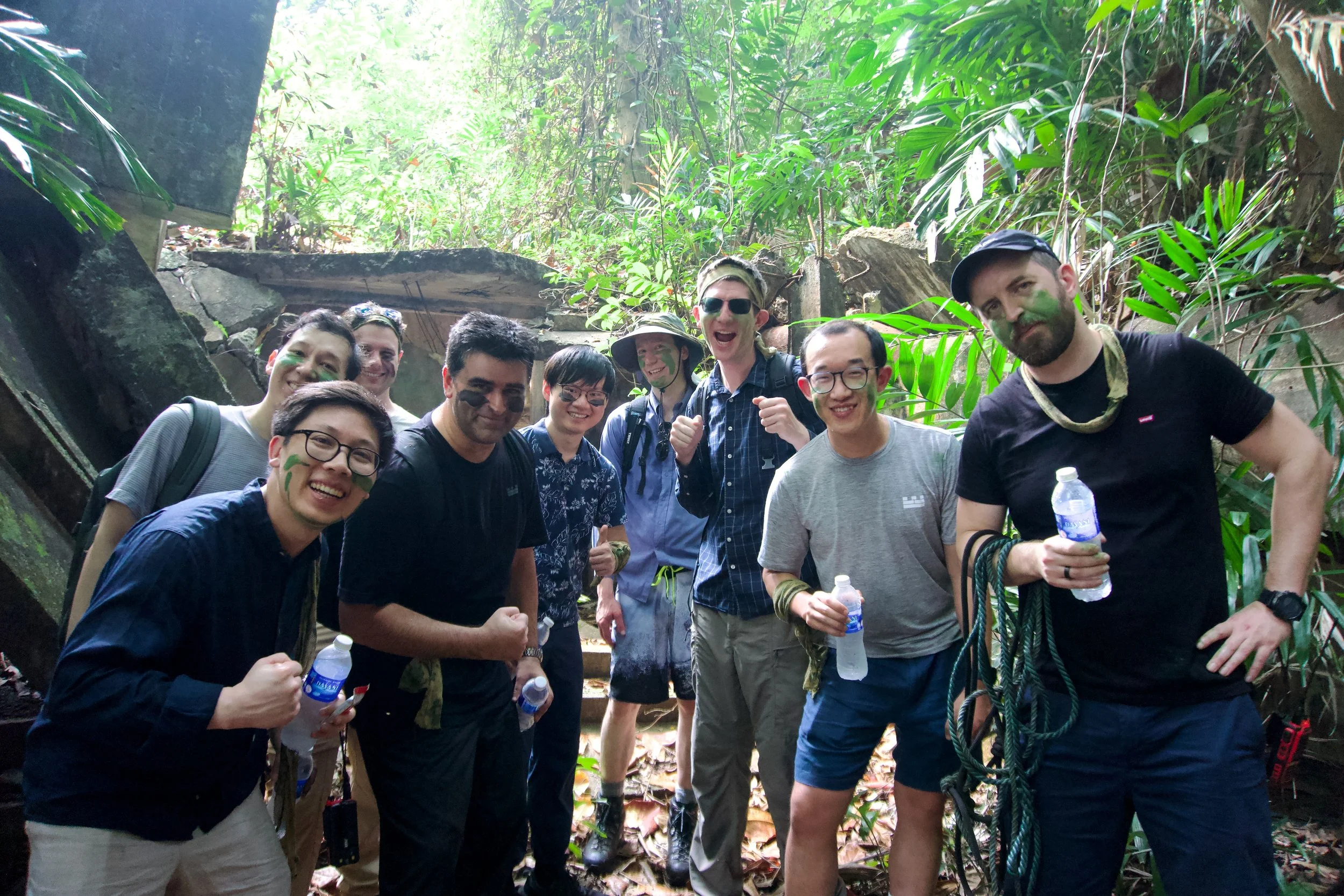
Nine people went in as colleagues. Two hours later they had one very strange shared story.
Frequently Asked Questions
-
Yes. Small groups can work particularly well at Fort Serapong because the programme can operate as one continuous unit rather than requiring multiple competing teams. Citadel Securities’ programme involved nine participants moving through one connected two-hour mission.
-
It can suit leadership groups, project teams, regional teams, finance and professional-services teams, or smaller departments that want something more immersive than a conventional workshop. The programme can be adjusted around the team’s objectives rather than using one fixed format for every group.
-
No previous survival experience is required. Activities are facilitated and introduced as part of the experience. The practical tasks are there to give the team something unfamiliar to solve together.
-
No. Although the mission included fire, a natural shelter at Granite Hill and an improvised stretcher, these skills were used inside a broader mission focused on decision-making, communication, prioritisation and problem-solving.
-
This Citadel Securities mission was designed as a two-hour experience. Programme duration can be adjusted depending on group size, objectives and the overall event schedule.
-
Yes. The mission structure can be adapted according to the team, timing, group profile and objectives. The aim is not simply to repeat the same activities for every company, but to design a sequence that makes sense for the group taking part.
No conference room. No opposing team. Just nine people, one clock and a fort that refused to solve itself.
Planning a small corporate team adventure in Singapore?
If your group is small, you do not need to make the programme feel artificially bigger.
Use the size.
A well-designed small-group programme can give every participant a meaningful role and let one continuous challenge develop instead of constantly resetting the room.
At Beyond Expeditions, our corporate programmes can be adapted around group size, timing, team profile and the sort of experience you actually want people to have.
Sometimes that means Fort Serapong.
Sometimes it means Pulau Ubin.
Sometimes it means fire, rope and thirty litres of pretend fuel disappearing into the Singapore jungle.
We take the brief from there.
Planning a small team day, leadership offsite or corporate adventure in Singapore? Tell us your team size, preferred date and what you want the group to get out of it. We’ll help design the rest.
Related corporate stories